Advertisements
Advertisements
प्रश्न
Give reasons for the following:
o-nitrophenol is more acidic than o-methoxyphenol.
Explain why is ortho nitrophenol more acidic than ortho methoxyphenol?
Advertisements
उत्तर १
Due to the strong –R and –I effect of the NO2 group, the electron density on the O–H bond decreases; hence, the proton is released easily.

After losing the proton, the remaining o-nitrophenoxide ion becomes stable by resonance.

Ortho-nitrophenoxide ion resonance is stable; hence, o-nitrophenol is a strong acid. On the other hand, due to the +R effect of the OCH3 group, the electron density on the O–H bond increases; hence, the removal of the proton becomes difficult.
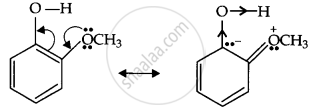
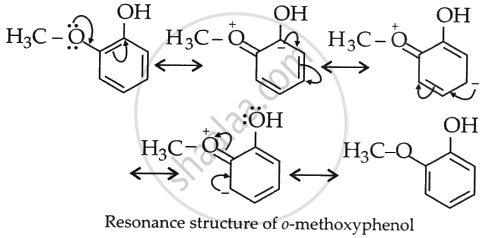
Now, the o-methoxyphenoxide ion, which remains after the loss of the proton, gets destabilised due to resonance.
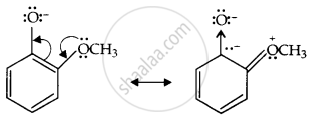
The two negative charges repel each other and destabilise the o-methoxyphenoxide ion, so o-nitrophenol is more acidic than o-methoxyphenol.
उत्तर २
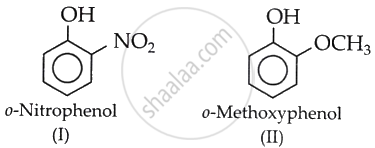
The acidity of phenol is due to the dissociation of a hydrogen ion (H+) from the hydroxyl (O–H) group. This loss increases if the O–H bond polarity intensifies and H carries a significant δ+ charge.
The presence of the strongly electron-withdrawing NO2 group at the ortho position in (I) increases the polarity of the O–H bond.
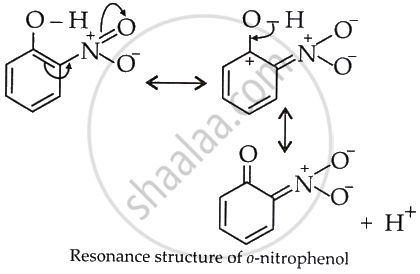
This helps in the release of H+ and increases acidity.
The reaction (II) is less acidic because –OCH3 is an electron-releasing group and increases the electron density on O of OH, and H+ release is suppressed. This can be understood from the resonance structures of II, which are:
संबंधित प्रश्न
Write the final product(s) in each of the following reactions:

Give the equation of the following reaction:
Oxidation of propan-1-ol with alkaline KMnO4 solution.
When 3-methylbutan-2-ol is treated with HBr, the following reaction takes place:
\[\begin{array}{cc}
\phantom{...................................}\ce{Br}\\
\phantom{..................................}|\\
\ce{CH3 - CH - CH - CH3 ->[HBr] CH3 - C - CH2 - CH3}\\
|\phantom{.........}|\phantom{...................................}|\phantom{...........}\\
\ce{CH3}\phantom{...}\ce{OH}\phantom{...............................}\ce{CH3}\phantom{.......}\\
\end{array}\]
Give a mechanism for this reaction.
(Hint: The secondary carbocation formed in step II rearranges to a more
stable tertiary carbocation by a hydride ion shift from 3rd carbon atom.)
Lucas test is used for the detection of _____________.
In the reduction \[\ce{R - CHO + H2 -> RCH2OH}\] the catalyst used is:
Dehydration of 2-butanol yields:
Cyclohexene is best prepared from cyclohexanol by which of the following:
\[\ce{CH3CH2OH}\] can be converted into \[\ce{CH3CHO}\] by ______.
In Kolbe’s reaction, instead of phenol, phenoxide ion is treated with carbon dioxide. Why?
What is Lucas reagent?
The correct geometry around oxygen in CH3OCH3 is
What happens when (CH3)3 C – OH is heated with Cu/573 K?
Write the chemical equation in support of your answer.
Which of the following observation is shown by 2-phenyl ethanol with Lucas Reagent?
Write the mechanism of acid dehydration of ethanol to yield ethene.
Write the mechanism of acid dehydration of ethanol to yield ethene.
Write the mechanism of acid dehydration of ethanol to yield ethene.
Write the mechanism of acid dehydration of ethanol to yield ethene.
Write the mechanism of acid dehydration of ethanol to yield ethene.
