Advertisements
Advertisements
प्रश्न
Write the mechanism of the following reaction:

Advertisements
उत्तर
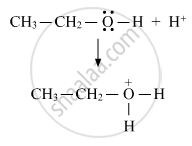
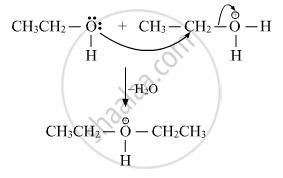
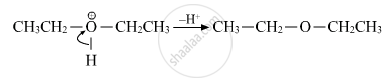
The mechanism of the given reaction is as follows:
(i) Protonation of an alcohol molecule
(ii) Attack of other alcohol molecule on the protonated molecule
(iii) Deprotonation
APPEARS IN
संबंधित प्रश्न
Write the mechanism (using curved arrow notation) of the following reaction :

Lucas reagent is ____________.
Primary and secondary alcohols on the action of reduced copper give:
Name the factors responsible for the solubility of alcohols in water.
Explain why is OH group in phenols more strongly held as compared to OH group in alcohols.
In Kolbe’s reaction, instead of phenol, phenoxide ion is treated with carbon dioxide. Why?
Ethers can be prepared by Williamson synthesis in which an alkyl halide is reacted with sodium alkoxide. Di-tert-butyl ether can’t be prepared by this method. Explain.
Which of the following alcohols will not undergo oxidation?
Write the mechanism of acid-catalysed dehydration of ethanol to yield ethene.
Write the mechanism of acid-catalysed dehydration of ethanol to yield ethene
