Advertisements
Advertisements
Questions
Give reasons for the following:
o-nitrophenol is more acidic than o-methoxyphenol.
Explain why is ortho nitrophenol more acidic than ortho methoxyphenol?
Advertisements
Solution 1
Due to the strong –R and –I effect of the NO2 group, the electron density on the O–H bond decreases; hence, the proton is released easily.

After losing the proton, the remaining o-nitrophenoxide ion becomes stable by resonance.

Ortho-nitrophenoxide ion resonance is stable; hence, o-nitrophenol is a strong acid. On the other hand, due to the +R effect of the OCH3 group, the electron density on the O–H bond increases; hence, the removal of the proton becomes difficult.
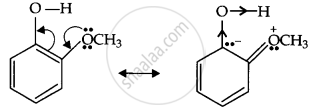
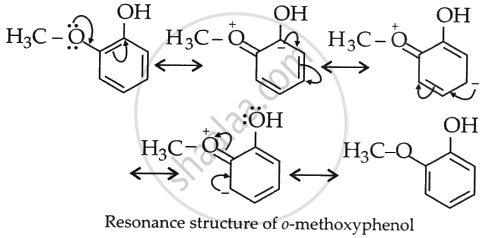
Now, the o-methoxyphenoxide ion, which remains after the loss of the proton, gets destabilised due to resonance.
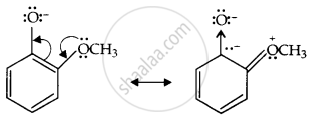
The two negative charges repel each other and destabilise the o-methoxyphenoxide ion, so o-nitrophenol is more acidic than o-methoxyphenol.
Solution 2
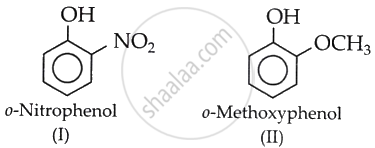
The acidity of phenol is due to the dissociation of a hydrogen ion (H+) from the hydroxyl (O–H) group. This loss increases if the O–H bond polarity intensifies and H carries a significant δ+ charge.
The presence of the strongly electron-withdrawing NO2 group at the ortho position in (I) increases the polarity of the O–H bond.
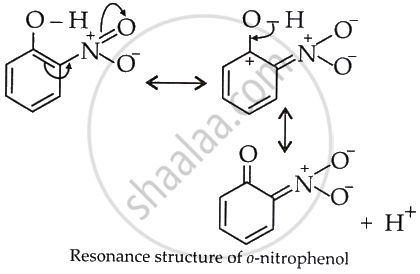
This helps in the release of H+ and increases acidity.
The reaction (II) is less acidic because –OCH3 is an electron-releasing group and increases the electron density on O of OH, and H+ release is suppressed. This can be understood from the resonance structures of II, which are:
RELATED QUESTIONS
Ortho and para nitrophenols are more acidic than phenol. Draw the resonance structures of the corresponding phenoxide ions.
Give the equation of the following reaction:
Dilute HNO3 with phenol.
Give the equation of the following reaction:
Treating phenol with chloroform in the presence of aqueous NaOH.
When 3-methylbutan-2-ol is treated with HBr, the following reaction takes place:
\[\begin{array}{cc}
\phantom{...................................}\ce{Br}\\
\phantom{..................................}|\\
\ce{CH3 - CH - CH - CH3 ->[HBr] CH3 - C - CH2 - CH3}\\
|\phantom{.........}|\phantom{...................................}|\phantom{...........}\\
\ce{CH3}\phantom{...}\ce{OH}\phantom{...............................}\ce{CH3}\phantom{.......}\\
\end{array}\]
Give a mechanism for this reaction.
(Hint: The secondary carbocation formed in step II rearranges to a more
stable tertiary carbocation by a hydride ion shift from 3rd carbon atom.)
Write the mechanism (using curved arrow notation) of the following reaction :

Which one of the following on oxidation gives a ketone?
Primary and secondary alcohols on the action of reduced copper give:
The compound which gives the most stable carbonium ion on dehydration is:
Cyclohexene is best prepared from cyclohexanol by which of the following:
Identify the secondary alcohols from the following set:
- \[\ce{CH3CH2CH(OH)CH3}\]
- \[\ce{(C2H5)3COH}\]
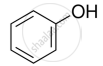

Mark the correct increasing order of reactivity of the following compounds with HBr/HCl.
| (a) | 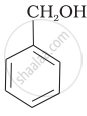 |
| (b) |  |
| (c) | 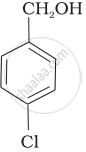 |
In Kolbe’s reaction, instead of phenol, phenoxide ion is treated with carbon dioxide. Why?
Ethers can be prepared by Williamson synthesis in which an alkyl halide is reacted with sodium alkoxide. Di-tert-butyl ether can’t be prepared by this method. Explain.
Why is the C – O – H bond angle in alcohols slightly less than the tetrahedral angle whereas the C – O – C bond angle in ether is slightly greater?
Assertion: Bond angle in ethers is slightly less than the tetrahedral angle.
Reason: There is a repulsion between the two bulky (–R) groups.
Write the mechanism of acid-catalysed dehydration of ethanol to yield ethene.
Write the mechanism of acid dehydration of ethanol to yield ethene.
Write the mechanism of acid dehydration of ethanol to yield ethene.
