Advertisements
Advertisements
Question
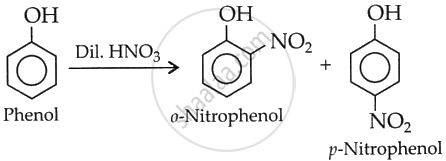
Give the equation of the following reaction:
Dilute HNO3 with phenol.
Advertisements
Solution
APPEARS IN
RELATED QUESTIONS
Give reasons for the following:
o-nitrophenol is more acidic than o-methoxyphenol.
Ortho and para nitrophenols are more acidic than phenol. Draw the resonance structures of the corresponding phenoxide ions.
Give the equation of the following reaction:
Treating phenol with chloroform in the presence of aqueous NaOH.
Name the reagent used in the following reaction:
Oxidation of a primary alcohol to carboxylic acid.
Name the reagent used in the following reaction:
Benzyl alcohol to benzoic acid.
Write the mechanism (using curved arrow notation) of the following reaction :

Lucas reagent is ____________.
The compound which reacts fastest with Lucas reagent at room temperature is:
Dehydration of 2-butanol yields:
Lucas test is done to differentiate between ____________.
During dehydration of alcohols to alkenes by heating with cone. H2SO4 the initial step is ____________.
Mark the correct increasing order of reactivity of the following compounds with HBr/HCl.
| (a) | 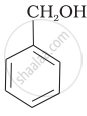 |
| (b) |  |
| (c) | 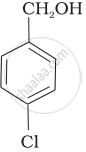 |
Name the factors responsible for the solubility of alcohols in water.
Suggest a reagent for the following conversion.
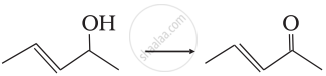
Explain why is OH group in phenols more strongly held as compared to OH group in alcohols.
What happens when (CH3)3 C – OH is heated with Cu/573 K?
Write the chemical equation in support of your answer.
Which of the following observation is shown by 2-phenyl ethanol with Lucas Reagent?
Write the mechanism of acid dehydration of ethanol to yield ethene.
Write the mechanism of acid-catalysed dehydration of ethanol to yield ethene.
Write the mechanism of acid-catalysed dehydration of ethanol to yield ethene
