Advertisements
Advertisements
Question
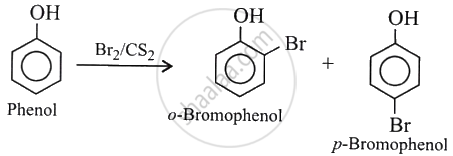
Give the equation of the following reaction:
Bromine in CS2 with phenol.
Advertisements
Solution

APPEARS IN
RELATED QUESTIONS
Write the equation involved in the following reaction:
Kolbe’s reaction
Explain the following with an example.
Kolbe’s reaction.
When phenol is treated with excess bromine water, it gives:
In the reaction of phenol with CHCl3 and aqueous NaOH at 343 K, the electrophile attacking the ring is:
When Phenol is distilled with zinc dust, it gives:


\[\ce{C2H5OH + SOCl2 ->[Pyridine] C2H5Cl + SO2 + HCl}\]
The above reaction is known as:
Which of the following reactions is used to prepare salicylaldehyde?
Phenol does not undergo nucleophilic substitution reaction easily due to ______.
Which of the following compounds is aromatic alcohol?
| (A) | ![]() |
| (B) | ![]() |
| (C) | ![]() |
| (D) | ![]() |
Which of the following are used to convert \[\ce{RCHO}\] into \[\ce{RCH2OH}\]?
(i) \[\ce{H2/Pd}\]
(ii) \[\ce{LiAlH4}\]
(iii) \[\ce{NaBH4}\]
(iv) Reaction with \[\ce{RMgX}\] followed by hydrolysis
Which of the following is not aromatic?
Why ortho-nitrophenol is steam volatile while para-nitrophenol is not?
Write the chemical equation involved in the following reactions:
Acetylation of salicylic add
For the pair phenol and cyclohexanol, answer the following:
Give one chemical test to distinguish between the two.
Write the name of the reaction, structure and IUPAC name of the product formed when:
Phenol reacts with CHCl3 in the presence of NaOH followed by hydrolysis.
Convert the following by giving a chemical equation:
Phenol to salicylaldehyde.