Advertisements
Advertisements
Question
Name the factors responsible for the solubility of alcohols in water.
Advertisements
Solution
Alcohols are soluble in water because of hydrogen bonding with water molecules.
\[\begin{array}{cc}
\phantom{}\ce{R - O - H ⋅⋅⋅ O - H ⋅⋅⋅ O - H ⋅⋅⋅ }\phantom{}\\
\phantom{.......}|\phantom{..........}|\phantom{.}\\
\phantom{.......}\ce{H}\phantom{.........}\ce{R}\phantom{.}
\end{array}\]
The solubility decreases with increase in size of alkyl or aryl group.
APPEARS IN
RELATED QUESTIONS
Give the equation of the following reaction:
Dilute HNO3 with phenol.
Give the equation of the following reaction:
Treating phenol with chloroform in the presence of aqueous NaOH.
Name the reagent used in the following reaction:
Oxidation of a primary alcohol to carboxylic acid.
Name the reagent used in the following reaction:
Benzyl alcohol to benzoic acid.
In the reduction \[\ce{R - CHO + H2 -> RCH2OH}\] the catalyst used is:
Which of the following are used to convert RCHO into RCH2OH?
(i) H2/Pd
(ii) LiAlH4
(iii) NaBH4
(iv) Reaction with RMgX followed by hydrolysis
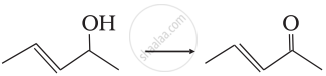
Suggest a reagent for the following conversion.
Alcohols react with active metals e.g. Na, K etc. to give corresponding alkoxides. Write down the decreasing order of reactivity of sodium metal towards primary, secondary and tertiary alcohols.
Why is the C – O – H bond angle in alcohols slightly less than the tetrahedral angle whereas the C – O – C bond angle in ether is slightly greater?
Assertion: Bond angle in ethers is slightly less than the tetrahedral angle.
Reason: There is a repulsion between the two bulky (–R) groups.
What is Lucas reagent?
Which of the following alcohols will not undergo oxidation?
Write the mechanism of acid-catalysed dehydration of ethanol to yield ethene.
Write the mechanism of acid dehydration of ethanol to yield ethene.
Write the mechanism of acid dehydration of ethanol to yield ethene.
Write the mechanism of acid dehydration of ethanol to yield ethene.
Write the mechanism of acid-catalysed dehydration of ethanol to yield ethene.
