Advertisements
Advertisements
Question
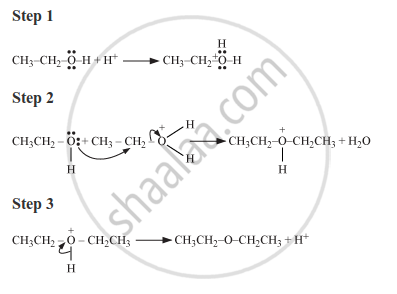
Write the mechanism of the following reaction :

Advertisements
Solution
The given reaction follows SN2 mechanism as shown below:
APPEARS IN
RELATED QUESTIONS
Write the final product(s) in each of the following reactions:

Name the reagent used in the following reaction:
Oxidation of a primary alcohol to aldehyde.
In the reduction \[\ce{R - CHO + H2 -> RCH2OH}\] the catalyst used is:
Dehydration of 2-butanol yields:
Identify the secondary alcohols from the following set:
- \[\ce{CH3CH2CH(OH)CH3}\]
- \[\ce{(C2H5)3COH}\]
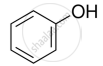

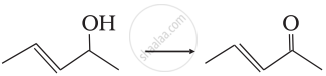
Suggest a reagent for the following conversion.
Why is the C – O – H bond angle in alcohols slightly less than the tetrahedral angle whereas the C – O – C bond angle in ether is slightly greater?
Write the mechanism of acid dehydration of ethanol to yield ethene.
Write the mechanism of acid dehydration of ethanol to yield ethene.
Write the mechanism of acid dehydration of ethanol to yield ethene.
