Advertisements
Advertisements
Question
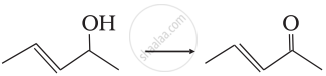
Suggest a reagent for the following conversion.
Advertisements
Solution
Pyridinium chlorochromate (PCC), a complex of chromium trioxide with pyridine and HCl.
\[\ce{CH3 - CH = CH - CH2OH ->[PCC] CH3 - CH = CH - CHO}\]
APPEARS IN
RELATED QUESTIONS
Give reasons for the following:
o-nitrophenol is more acidic than o-methoxyphenol.
Write the mechanism of the following reaction :

Give the equation of the following reaction:
Oxidation of propan-1-ol with alkaline KMnO4 solution.
Write the mechanism of acid-catalysed dehydration of ethanol to yield ethene.
Cyclohexene is best prepared from cyclohexanol by which of the following:
\[\ce{CH3CH2OH}\] can be converted into \[\ce{CH3CHO}\] by ______.
The process of converting alkyl halides into alcohols involves ______.
In Kolbe’s reaction, instead of phenol, phenoxide ion is treated with carbon dioxide. Why?
What happens when (CH3)3 C – OH is heated with Cu/573 K?
Write the chemical equation in support of your answer.
Which of the following observation is shown by 2-phenyl ethanol with Lucas Reagent?
Write the mechanism of acid dehydration of ethanol to yield ethene.
Write the mechanism of acid dehydration of ethanol to yield ethene.
Write the mechanism of acid dehydration of ethanol to yield ethene.
Write the mechanism of acid-catalysed dehydration of ethanol to yield ethene.
Write the mechanism of acid-catalysed dehydration of ethanol to yield ethene
