Advertisements
Advertisements
प्रश्न
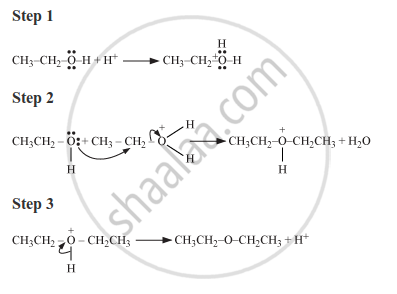
Write the mechanism of the following reaction :

Advertisements
उत्तर
The given reaction follows SN2 mechanism as shown below:
APPEARS IN
संबंधित प्रश्न
Write the mechanism of the following reaction:

Write the mechanism (using curved arrow notation) of the following reaction :

Lucas test is used for the detection of _____________.
The compound which reacts fastest with Lucas reagent at room temperature is:
Lucas test is done to differentiate between ____________.
Name the factors responsible for the solubility of alcohols in water.
Write the mechanism of acid-catalysed dehydration of ethanol to yield ethene.
Write the mechanism of acid dehydration of ethanol to yield ethene.
Write the mechanism of acid dehydration of ethanol to yield ethene.
Write the mechanism of acid-catalysed dehydration of ethanol to yield ethene.
