Advertisements
Advertisements
Question
When 3-methylbutan-2-ol is treated with HBr, the following reaction takes place:
\[\begin{array}{cc}
\phantom{...................................}\ce{Br}\\
\phantom{..................................}|\\
\ce{CH3 - CH - CH - CH3 ->[HBr] CH3 - C - CH2 - CH3}\\
|\phantom{.........}|\phantom{...................................}|\phantom{...........}\\
\ce{CH3}\phantom{...}\ce{OH}\phantom{...............................}\ce{CH3}\phantom{.......}\\
\end{array}\]
Give a mechanism for this reaction.
(Hint: The secondary carbocation formed in step II rearranges to a more
stable tertiary carbocation by a hydride ion shift from 3rd carbon atom.)
Advertisements
Solution
The described reaction is an example of carbocation rearrangement that occurs via hydride shift. The mechanism for it is:
Step 1: Formation of carbocation: Protonation of alcohol.
\[\ce{HBr -> H+ + B\overset{-}{r}}\]


Step 2: 1,2-hydride shift: Formation of a more stable, 3° carbocation.
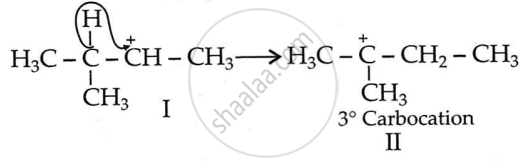
Initially, a 2° carbocation (I) was produced. However, the more stable 3° counterpart causes a hydride shift, forming the more stable carbocation (II).
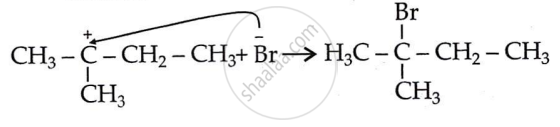
Step 3: Attack of nucleophile: Generation of product.
APPEARS IN
RELATED QUESTIONS
Write the final product(s) in each of the following reactions:

Write the mechanism of the following reaction:

Write the mechanism of the following reaction :

Give the equation of the following reaction:
Oxidation of propan-1-ol with alkaline KMnO4 solution.
Name the reagent used in the following reaction:
Oxidation of a primary alcohol to aldehyde.
Name the reagent used in the following reaction:
Benzyl alcohol to benzoic acid.
The compound which reacts fastest with Lucas reagent at room temperature is:
By which of the following methods alcohol can be prepared in excellent yield?
The compound which gives the most stable carbonium ion on dehydration is:
Cyclohexene is best prepared from cyclohexanol by which of the following:
Identify the secondary alcohols from the following set:
- \[\ce{CH3CH2CH(OH)CH3}\]
- \[\ce{(C2H5)3COH}\]

Name the factors responsible for the solubility of alcohols in water.
Alcohols react with active metals e.g. Na, K etc. to give corresponding alkoxides. Write down the decreasing order of reactivity of sodium metal towards primary, secondary and tertiary alcohols.
Assertion: Bond angle in ethers is slightly less than the tetrahedral angle.
Reason: There is a repulsion between the two bulky (–R) groups.
Which of the following alcohols will not undergo oxidation?
Write the mechanism of acid-catalysed dehydration of ethanol to yield ethene.
Write the mechanism of acid-catalysed dehydration of ethanol to yield ethene.
