Advertisements
Advertisements
प्रश्न
When 3-methylbutan-2-ol is treated with HBr, the following reaction takes place:
\[\begin{array}{cc}
\phantom{...................................}\ce{Br}\\
\phantom{..................................}|\\
\ce{CH3 - CH - CH - CH3 ->[HBr] CH3 - C - CH2 - CH3}\\
|\phantom{.........}|\phantom{...................................}|\phantom{...........}\\
\ce{CH3}\phantom{...}\ce{OH}\phantom{...............................}\ce{CH3}\phantom{.......}\\
\end{array}\]
Give a mechanism for this reaction.
(Hint: The secondary carbocation formed in step II rearranges to a more
stable tertiary carbocation by a hydride ion shift from 3rd carbon atom.)
Advertisements
उत्तर
The described reaction is an example of carbocation rearrangement that occurs via hydride shift. The mechanism for it is:
Step 1: Formation of carbocation: Protonation of alcohol.
\[\ce{HBr -> H+ + B\overset{-}{r}}\]


Step 2: 1,2-hydride shift: Formation of a more stable, 3° carbocation.
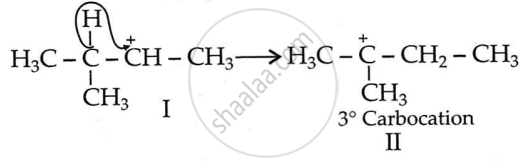
Initially, a 2° carbocation (I) was produced. However, the more stable 3° counterpart causes a hydride shift, forming the more stable carbocation (II).
Step 3: Attack of nucleophile: Generation of product.
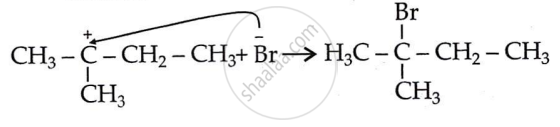
APPEARS IN
संबंधित प्रश्न
Write the final product(s) in each of the following reactions:

Give reasons for the following:
o-nitrophenol is more acidic than o-methoxyphenol.
Write the mechanism of the following reaction:

Write the mechanism of acid-catalysed dehydration of ethanol to yield ethene.
Name the reagent used in the following reaction:
Oxidation of a primary alcohol to aldehyde.
Lucas test is used for the detection of _____________.
The compound which reacts fastest with Lucas reagent at room temperature is:
Which of the following are used to convert RCHO into RCH2OH?
(i) H2/Pd
(ii) LiAlH4
(iii) NaBH4
(iv) Reaction with RMgX followed by hydrolysis
Which of the following is not true in case of reaction with heated copper at 300°C?
During dehydration of alcohols to alkenes by heating with cone. H2SO4 the initial step is ____________.
Identify the secondary alcohols from the following set:
- \[\ce{CH3CH2CH(OH)CH3}\]
- \[\ce{(C2H5)3COH}\]
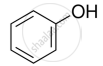

In Kolbe’s reaction, instead of phenol, phenoxide ion is treated with carbon dioxide. Why?
What is Lucas reagent?
What happens when (CH3)3 C – OH is heated with Cu/573 K?
Write the chemical equation in support of your answer.
Write the mechanism of acid dehydration of ethanol to yield ethene.
Write the mechanism of acid dehydration of ethanol to yield ethene.
Write the mechanism of acid-catalysed dehydration of ethanol to yield ethene.
