Advertisements
Advertisements
Question
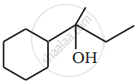
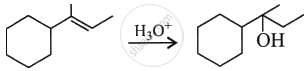
Show how you would synthesise the following alcohol from an appropriate alkene?
Advertisements
Solution 1
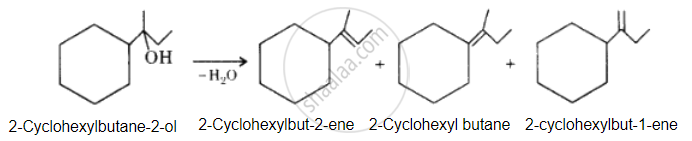
The desired alcohol is obtained from any of these alkenes by adding H2O in the presence of acid.
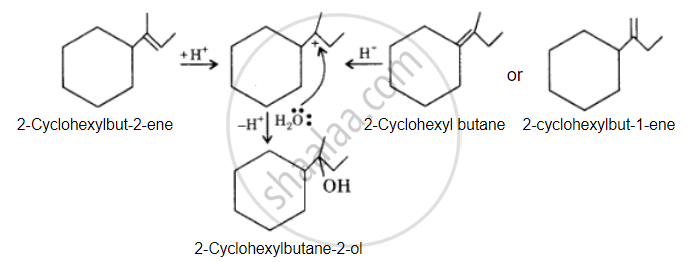
Solution 2
APPEARS IN
RELATED QUESTIONS
Name the reagents used in the following reactions:

Write the main product(s) in each of the following reactions:

How do you convert the following : Propan-2-ol to 2-methylpropan-2-ol
Predict the major product of acid catalysed dehydration of 1-methylcyclohexanol.
Name the reagent used in the following reaction:
Butan-2-one to butan-2-ol.
How will you convert: Phenol to 2, 4, 6 − trinitrophenol?
Write the structure of main compounds A and B in the following reaction:
\[\ce{CH3CH2CN->[CH3MgBRH/3O+]A->[LiAIH4]B}\]
Ketones react with Grignard reagent to produce ____________.
Aldehydes are reduced to the corresponding alcohols by the addition of hydrogen in the presence of catalysts to form ____________.
Which of the following reacts with NaOH to give alcohol?
Explain a process in which a biocatalyst is used in industrial preparation of a compound known to you.
Select the acid(s) which cannot be prepared by Grignard reagent.
Alkaline hydrolysis of an alkyl halide can be preferably carried out using ______.
The major product of acid catalysed dehydration of 1-methylcyclohexanol is ______.
To synthesise 1.0 mole of 2-methylpropan-2-ol from Ethylethanoate ______ equivalents of CH3MgBr reagent will be required. (Integer value)
An aldehyde isomeric with allyl alcohol gives phenyl hydrazone. Pick out a ketone that too gives a phenyl hydrazone containing the same percentage of nitrogen.
\[\ce{C3H8O ->[{[O]}][K2Cr2O7/H2SO4] C3H6O ->[I2 + NaOH(aq.)] CHI3}\]
In this reaction the first compound is:
For distinction between \[\ce{CH3CHO}\] and \[\ce{C6H5CHO}\] the reagent used is ______.
Ceric aminonium nitrate and CHCl3/alc. KOH are used for the identification of functional groups present in ______ and ______ respectively.
Write the mechanism of acid dehydration of ethanol to yield ethene.
