- A concave mirror has an inward-curved reflecting surface, while a convex mirror has an outward-curved reflecting surface.
- Important parts of a spherical mirror: Pole (P), Centre of Curvature (C), Principal Axis, and Principal Focus (F).
- For spherical mirrors, the relation is R = 2f, where R is the radius of curvature and f is the focal length.
- In concave mirrors, parallel rays converge at the focus; in convex mirrors, they appear to diverge from the focus behind the mirror.
Revision: Natural Phenomena >> Light – Reflection and Refraction Science English Medium Class 10 CBSE
Advertisements
Definitions [44]
Definition: Ray Optics
The branch of optics that is based on rectilinear propagation of light and deals with mirrors, lenses, reflection, refraction, etc. is called ray optics.
Definition: Wave Optics
The branch of optics that considers light as a wave which can bend around objects, diffract and interfere, etc. is called wave optics.
Definition: Polarisation
The phenomenon that is based on the fact that light waves are transverse electromagnetic waves is called polarisation.
Definition: Electromagnetic Wave (Maxwell)
Coupled time-varying electric and magnetic fields that propagate in space are called electromagnetic waves.
Definition: Reflection of Light
The phenomenon of bouncing back of light rays in the same medium on striking a surface is called reflection of light.
Define the term Principle axis.
The principal axis is the straight line passing through the pole and the centre of curvature.
Define Regular reflection.
The phenomenon due to which a parallel beam of light traveling through a certain medium, on striking some polished surface, bounces off from it, as a parallel beam, in some other direction, is called regular reflection.
Define reflection.
The bouncing of light by any smooth or polished surface is called.
Explain the following term:
Normal Draw
diagram/diagrams to show them.
Normal: The perpendicular drawn at the point of incidence, to the surface of the mirror is called normal.

By drawing a neat diagram define the following:
Mirror
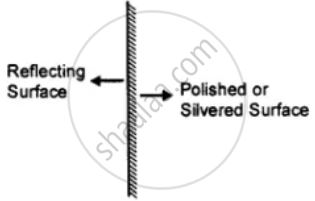
The mirror is a highly polished and smooth surface that reflects almost the entire light falling on it. A plane mirror is made by silvering one side of a glass plate as shown in the figure.
Representation of plane mirror
Define the following term in relation to concave mirror.
Principal axis
An imaginary line passing through the pole and the centre of curvature of a spherical mirror is called principal axis.
Define the following term in relation to concave mirror.
Principal focus
It is a point on the principal axis, where a beam of light, parallel to the principal axis, after reflection actually meet.
Define the following term in relation to concave mirror.
Radius of curvature
The linear distance between the pole and the center of curvature is called the radius of curvature.
Define the following term in relation to concave mirror.
Focal length
The linear distance between the pole and the principal focus is called focal length.
Define the term Focus of a concave mirror.
The focus of a concave mirror is a point on the principal axis of the mirror, where all the rays travelling parallel to the principal axis and close to it after reflection from the mirror converge to that point.
Define the term Normal.
Normal to the surface of a mirror at any point is the straight line at the right angle to the tangent drawn at that point.
Define the following term:
spherical mirror
“A mirror which is made from a part of a hollow sphere is called Spherical Mirror.
Define focal length.
The distance between the pole and the principal focus is called the focal length (f) of a spherical mirror.
Define the term Pole.
Pole is the centre of the reflecting surface, in this case, a spherical mirror.
Define the term Aperture.
Aperture is the distance between the extreme points on the periphery of the mirror.
Define the term Centre of curvature.
Centre of curvature is the centre of the imaginary sphere to which the mirror belongs.
Define the term Principle focus.
Principal focus of a spherical mirror is a point on the principal axis of the mirror, where all the rays travelling parallel to the principal axis and close to it after reflection from the mirror, converge to or appear to diverge from.
Define the following term:
convex mirror
“A mirror made by silvering the inner surface such that reflection takes place from the bulging surface” is called Convex Mirror.
The Centre of curvature is towards the silvered surface.
Define the following term:
concave mirror
“A mirror made by silvering the outer or the bulging surface such that the reflection takes place from the concave surface.” Centre of curvature is towards the reflecting surface.
Define the following term in relation to concave mirror.
Pole
Pole “is the mid-point of the mirror”.
Define the following term in relation to concave mirror.
Center of curvature
The centre of a hollow sphere of which the mirror forms a part is called the centre of curvature.
Definition: Spherical Mirrors
Mirrors whose reflecting surfaces are spherical are called spherical mirrors.
OR
A spherical mirror is a part of a hollow sphere, whose one side is silvered and coated with red oxide and the other side is the reflecting surface.
OR
A spherical mirror is a piece cut out of a spherical surface, which can be concave or convex.
Definition: Concave Mirror
A spherical mirror, whose reflecting surface is curved inwards, that is, faces towards the centre of the sphere, is called a concave mirror.
OR
A concave mirror is one whose reflecting surface is towards the centre of the sphere of which the mirror is a part.
OR
The reflecting surface is on the inner side of the sphere (converging mirror).
Definition: Convex Mirror
A spherical mirror whose reflecting surface is curved outwards, is called a convex mirror.
OR
A convex mirror is one whose reflecting surface is away from the centre of the sphere of which the mirror is a part.
OR
The reflecting surface is on the outer side of the sphere (diverging mirror).
Definition: Radius of Curvature
The radius of the sphere of which the reflecting surface of a spherical mirror forms a part is called the radius of curvature of the mirror. It is represented by the letter R.
OR
The radius of the sphere of which the mirror forms a part, is called the 'radius of curvature' of the mirror.
Definition: Principal Axis
A straight line passing through the pole and the centre of curvature of a spherical mirror. This line is called the principal axis.
OR
The straight line joining the pole and the centre of curvature of the mirror and extended on both sides is called the 'principal axis' of the mirror.
Definition: Pole
The centre of the reflecting surface of a spherical mirror is a point called the pole. The pole is usually represented by the letter P.
OR
The central point of the reflecting surface of the mirror is called the 'pole' of the mirror.
Definition: Centre of Curvature
The reflecting surface of a spherical mirror forms a part of a sphere. This sphere has a centre. This point is called the centre of curvature of the spherical mirror. It is represented by the letter C.
OR
The centre of the sphere of which the mirror forms a part, is called the ‘centre of curvature' of the mirror.
Definition: Refracted Light
Refracted light is the part of light enters into the other medium and travels in a straight path but in a direction different from its initial direction and is called the refracted light.
Define the principal focus of a concave mirror.
Light rays that are parallel to the principal axis of a concave mirror converge at a specific point on its principal axis after reflecting from the mirror. This point is known as the principal focus of the concave mirror.
Definition: Refraction of Light
When travelling obliquely from one medium to another, the direction of propagation of light in the second medium changes. This phenomenon is known as refraction of light.
OR
Light changes its direction when going from one transparent medium to another transparent medium. This is called the refraction of light.
OR
The bending of the light ray from its path in passing from one medium to the other medium is called 'refraction' of light.
OR
When a ray of light impinges on a polished, smooth, shiny surface, the rebounding of light within the same medium is called reflection of light.
Definition: Normal
A normal is an imaginary line drawn perpendicular to the boundary at the point of incidence.
Definition: Refracted Ray
The ray that enters the second medium after crossing the boundary is called the refracted ray.
Definition: Refraction
The change in the direction of the path of light when it passes from one transparent medium to another transparent medium is called refraction. The refraction of light is essentially a surface phenomenon.
or
When light passes from one transparent medium to another, its speed and direction change. This is called refraction.
Define the following terms used in the study of reflection of light by drawing a labelled ray-diagram:
- Incident ray
- Point of incidence
- Normal
- Reflected ray
- Angle of incidence
- Angle of reflection
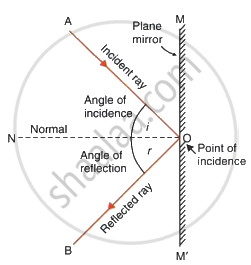
- Incident ray: The ray of light which falls on the mirror surface is called the incident ray.
- Point of incidence: The point at which the incident ray falls on the mirror is called the point of incidence.
- Normal: The normal is a line at right angles to the mirror surface at the point of incidence.
- Reflected ray: The ray of light which is sent back by the mirror is called the reflected ray.
- Angle of incidence: The angle of incidence is the angle made by the incident ray with the normal at the point of incidence.
- Angle of reflection: The angle of reflection is the angle made by the reflected ray with the normal at the point of incidence.
Definition: Refractive Index
The refractive index of second medium with respect to the first medium is defined as the ratio of the sine of the angle of incidence in the first medium to the sine of the angle of refraction in the second medium.
Definition: Power of a Lens
The deviation of the incident light rays produced by a lens on refraction through it, is a measure of its power.
or
The power of a lens is defined as the reciprocal of its focal length. It is represented by the letter P.
OR
The power (P) of a thin lens is equal to the reciprocal of its focal length (f) measured in metres.
Definition: Unit of Power
The SI unit of power of a lens is the dioptre.
One dioptre is the power of a lens whose focal length is 1 metre.
1D = 1m−1
Define the power of a lens.
Power of a lens is defined as the ability of a lens to bend the rays of light. It is given by the reciprocal of focal length in metre.
The power of a lens is a measure of the deviation produced by it in the path of rays refracted through it.
Formulae [6]
Formula: Number of Images in Inclined Mirrors
n = \[\frac {360°}{θ}\]
- If n is even → N = n − 1
- If n is odd → N = n (object not on bisector); N = n − 1 (object on bisector)
- If n is a fraction → N = integral part of n
Write the formula for a lens connecting image distance (v), object distance (u) and the focal length (f). How does the lens formula differ from the mirror formula?
Lens formula is:
`1/v-1/u=1/f`
Now, the mirror formula is given by:
`1/v+1/u=1/f`
In both the formulas,
u = Object distance
v = Image distance
f = Focal length
In the mirror formula, a positive sign is present between the reciprocals of the image distance and object distance.
In lens formula, a negative sign is present between the reciprocals of image distance and object distance.
Formula: Refractive Index
The refractive index of medium 2 w.r.to medium 1:
\[n_{21} = \frac{\text{Speed of light in medium 1}}{\text{Speed of light in medium 2}} = \frac{v_1}{v_2}\]
The refractive index of medium 1 w.r.to medium 2:
\[n_{12}=\frac{\text{Speed of light in medium 2}}{\text{Speed of light in medium 1}}=\frac{v_{2}}{v_{1}}\]
The refractive index of the medium nm is given by:
\[n_{m} = \frac{\text{Speed of light in air}}{\text{Speed of light in the medium}} = \frac{c}{v}\]
OR
\[\frac {\text{sin i}}{\text{sin r}}\] = constant = n
n is called the refractive index of the second medium with respect to the first medium.
Formula: Lens Formula
\[\frac {1}{v}\] - \[\frac {1}{u}\] = \[\frac {1}{f}\]
Formula: Lens Magnification
Magnification (m) = \[\frac{\text{Height of the Image}}{\text{Height of the object}}=\frac{h^{\prime}}{h}\]
Magnification in terms of object and image distances:
Magnification (m ) = \[\frac {h'}{h}\] = \[\frac {v}{u}\]
Formula: Power of a Lens
Power of lens (in D) = \[\frac{1}{\text{focal length (in metre)}}\]
or
P = \[\frac {1}{f}\]
or
P = \[\frac {1}{f (m)}\]
Power of a Lens in a Medium:
P = (n2 - n1)\[\left(\frac{1}{R_{1}}-\frac{1}{R_{2}}\right)\] = \[\frac {n_1}{f}\]
Theorems and Laws [4]
Law: Laws of Reflection
- The angle of incidence ∠i = angle of reflection ∠r.
- The incident ray, reflected ray, and normal lie in one plane; both rays are on either side of the normal.
Law: Laws of Reflection
- The angle of reflection is equal to the angle of incidence.
- The incident ray, the reflected ray, and the normal lie in the same plane.
- The incident ray and the reflected ray are on opposite sides of the normal.
Law: Laws of Refraction
The laws of refraction are fundamental for board examinations and objective tests.
First law
The incident ray, the refracted ray, and the normal at the point of incidence all lie in the same plane.
Second law
For a given pair of media, the ratio of the sine of the angle of incidence to the sine of the angle of refraction remains constant.
\[\frac {\text {sin i}}{\text {sin r}}\] = constant
This constant is called the refractive index of the second medium with respect to the first medium.
Law: Snell's Law
- The incident ray, the refracted ray and the normal at the point of incidence, all lie in the same plane.
- The ratio of the sine of the angle of incidence i to the sine of the angle of refraction r is constant for the pair of given media. i.e., mathematically
\[\frac {\text{sin i}}{\text{sin r}}\] = constant = n
Where:
- i = angle of incidence
- r = angle of refraction
- n = refractive index of the second medium with respect to the first
This ratio is constant for a given pair of media and is known as the refractive index.
Note: If a light ray is incident along the normal (i = 0∘), it passes undeviated into the second medium (r = 0∘).
Key Points
Key Points: Nature of Light
- Light consists of energy-carrying photons guided by the rules of electromagnetic (EM) waves.
- Commonly observed phenomena of light are broadly classified into three categories: Ray optics, Wave optics, and Particle nature of light.
- Light thus exhibits a dual nature — it behaves both as a wave (wave optics) and as a particle (photon/particle nature), depending on the phenomenon observed.
Key Points: Reflection of Light
- Reflection occurs when light bounces off a smooth surface like a mirror, following fixed laws.
- Plane mirrors always form virtual, erect, and same-sized images that are laterally inverted.
- Curved surfaces (like a spoon) act as spherical mirrors, changing the image size and orientation depending on the object's position.
Key Points: Spherical Mirrors
Important Questions [49]
- State the two laws of reflection of light.
- One half of a convex lens of focal length 10 cm is covered with a black paper. Can such a lens produce an image of a complete object placed at a distance of 30 cm from the lens? Draw a ray diagram to justify your answer. A 4 cm tall object is placed perpendicular to its principal axis of a convex lens of focal length 20 cm.
- A student obtains a sharp image of the distant window (W) of the school laboratory on the screen (S) using the given concave mirror (M) to determine its focal length.
- A student used a device (X) to obtain/focus the image of a well illuminated distant building on a screen (S) as shown below in the diagram. Select the correct statement about the device (X).
- A 4 cm tall object is placed on the principal axis of a convex lens. The distance of the object from the optical centre of the lens is 12 cm and its sharp image is formed at a distance of 24 cm from it on a screen on the other side of the lens.
- Explain the Following Term Related to Spherical Lenses:- Optical Centre
- A Student Focused the Sun Rays Using an Optical Device 'X' on a Screen S as Shown.
- Define the Following Term in the Context of Spherical Mirrors:- Pole
- Define the Following Term in the Context of Spherical Mirrors:- Centre of Curvature
- Define the Following Term in the Context of Spherical Mirrors:- Principal Axis
- Define the Following Term in the Context of Spherical Mirrors:- Principal Focus
- Define the following terms in the context of a diverging mirror: Principal focus Focal length Draw a labelled ray diagram to illustrate your answer.
- What is the difference between virtual images of an object formed by a concave mirror and a convex mirror?
- In torches, search lights and headlights of vehicles the bulb is placed ______.
- Answer the Following Question. Write the Modification in the Curvature of the Eye Lens Which Enables Us to See the Nearby Objects Clearly?
- Explain the Following Term Related to Spherical Lenses:- Centres of Curvature
- Explain the Following Term Related to Spherical Lenses:- Principal Axis
- Explain the Following Term Related to Spherical Lenses:- Aperture
- Explain the Following Term Related to Spherical Lenses:- Principal Focus
- Explain the Following Term Related to Spherical Lenses: Focal Length
- Draw a ray diagram to show the formation of the image, when the object is placed between optical centre and principal focus of a convex lens.
- The Shiny Outer Surface of a Hollow Sphere of Aluminium of Radius 50 Cm is to Be Used as a Mirror: What Will Be the Focal Length of this Mirror?
- The Shiny Outer Surface of a Hollow Sphere of Aluminium of Radius 50 Cm is to Be Used as a Mirror: Which Type of Spherical Mirror Will It Provide?
- Define the Following Terms in the Context of Spherical Mirrors :(I) Pole(Ii) Centre of Curvature(Iii) Radius of Curvature(Iv) Principal Axis
- An Optical Device Has Been Given to a Student and He Determines Its Focal Length by Focusing the Image of the Sun on a Screen Placed 24 Cm from the Device on the Same Side as the Sun.
- Ab and Cd, Two Spherical Mirrors, from Parts of a Hollow Spherical Ball with Its Centre at O as Shown in the Diagram.
- State the Types of Mirrors Used for (I) Headlights and (Ii) Rear View Mirror, in Cars and Motorcycles. Give to Justify Your Answer in Each Case.
- A Student Obtained on a Screen the Sharp Image of a Candle Flame Placed at the Farther End of Laboratory Table Using a Concave Mirror. for Getting Better Value of Focal Length of the Mirror,
- A Student Obtained a Sharp Image of a Burning Candle, Placed at the Farther End of a Laboratory Table, on a Screen Using a Concave Mirror. for Getting Better Value of Focal Length of the Mirror,
- Mention the Types of Mirrors Used as (I) Rear View Mirrors, (Ii) Shaving Mirrors. List Two Reasons to Justify Your Answers in Each Case.
- The Size of Image of an Object by a Convex Lens of Focal Length 20 Cm is Observed to Be Reduced to 1 3 Rd of Its Size . Find the Distance of the Object from the Optical Centre of the Lens .
- What is Atmospheric Reflection? Explain with the Help of a Labelled Diagram that the Position of a Star as Seen by Us is Not Its True Position.
- List Four Characteristics of the Image Formed by a Concave Lens of Focal Length 20 Cm When the Object is Placed at a Distance of 40 Cm from Its Optical Centre.
- List in Proper Sequence the Steps of the Experiment for Determining the Approximate Focal Length of a Given Concave Mirror by Obtaining the Image of a Distant Object.
- Explain how the formation of a rainbow occurs.
- A real image is formed by the light rays after reflection or refraction when they: (A) actually meet or intersect with each other. (B) actually converge at a point.
- The laws of reflection hold true for ______.
- A ray of light starting from diamond is incident on the interface separating diamond and water. Draw a labelled ray diagram to show. the refraction of light in this case.
- An object of height 10 cm is placed 25 cm away from the optical centre of a converging lens of focal length 15 cm. Calculate the image distance and height of the image formed.
- Define the power of a lens.
- You Have Two Lenses a and B of Focal Lengths +10 Cm and –10 Cm, Respectively. State the Nature and Power of Each Lens. Which of the Two Lenses Will Form a Virtual and Magnified Image of an Object
- Name the type of lens whose power is positive.The image of an object formed by a lens is real, inverted and of the same size as the object. If the image is at a distance of 40 cm from the lens
- A Student Uses a Lens of Focal Length 40 Cm and Another of –20 Cm. Write the Nature and Power of Each Lens.
- Mohan Obtained a Sharp Inverted Image of a Distant Tree on the Screen Placed Behind the Lens. He Then Moved the Screen and Tried to Look Through the Lens in the Direction of the Object. He Would See:
- How unit of power related to focal length of a lens?
- State the power of a lens S.I. unit.
- What is meant by a power of a lens? Define its SI unit.
- An object is kept at a distance of 1m from a lens of power +2D: Identify the type of lens. Calculate its focal length and distance of the image formed.
- What does sign of power (+ve or –ve) indicate?
Concepts [32]
- Nature of Light
- Reflection of Light
- Reflection of Light from Plane Surfaces: Plane Mirror
- Law of Reflection of Light
- Regular Reflection and Diffuse Reflection of Light
- Objects and Images
- Images Formed by a Plane Mirrors
- The Position of Image Formed in a Plane Mirror
- Uses of Plane Mirrors
- Spherical Mirrors
- Image Formation by Spherical Mirrors
- Rules for Obtaining Images Formed by Concave Mirrors
- Formation of Different Types of Images by a Concave Mirror
- Representation of Images Formed by Spherical Mirrors Using Ray Diagrams
- Sign Convention for Reflection by Spherical Mirrors
- Mirror Formula and Magnification
- Rules for Obtaining Images Formed by Convex Mirrors
- Formation of Image by a Convex Mirror
- Refraction of Light
- Effects of Refraction of Light
- Laws of Refraction of Light
- Refraction and Reflection in a Glass Slab
- The Refractive Index
- Refraction by Spherical Lenses
- Rules for Obtaining Images Formed by Convex Lenses
- Formation of Different Types of Images by a Convex Lens
- Image Formation by Lenses
- Image Formation in Lenses Using Ray Diagrams
- Sign Convention for Reflection by Spherical Mirrors
- Lens Formula and Magnification
- Lens Formula and Magnification Formulae for a Concave Lens
- Power of a Lens
