Topics
Reproduction in Organisms
Sexual Reproduction in Flowering Plants
- Flower
- Pre-fertilisation in Flowering Plant: Structures and Events
- Structure and Development of Anther
- Microsporogenesis
- Structure and Development of Male Gametophyte
- Pollen Viability and Storage
- Structure and Development of Ovule
- Megasporogenesis
- Development of Female Gametophyte or Embryo Sac
- Pollination
- Autogamy
- Geitonogamy
- Cross-pollination
- Agents of Pollination
- Anemophily
- Hydrophily
- Animal-Mediated Pollination (Zoophily)
- Outbreeding Devices
- Pollen Pistil Interaction
- Artificial Hybridization or Artificial Fertilization
- Double Fertilization and Triple Fusion
- Events in Sexual Reproduction > Post-Fertilization Structures and Events
- Endosperm
- Dicotyledonous Embryo
- Monocotyledonous Embryo
- The Seed
- Apomixis
- Polyembryony
Reproduction
Genetics and Evolution
Human Reproduction
- Human Reproduction
- The Male Reproductive System
- The Female Reproductive System
- Gametogenesis
- Spermatogenesis
- Structure of Sperm
- Spermiogenesis
- Oogenesis
- Menstrual Cycle (Ovarian Cycle)
- Major Events of Menstrual Cycle
- Menstrual Hygiene
- Fertilization in Human
- Implantation in Human
- Pregnancy and Embryonic Development
- Parturition (Birth) in Human
- Lactation in Human
Reproductive Health
- Concept of Reproductive Health
- Population Explosion and Control Measures
- Birth Control
- Natural Contraceptive Methods
- Artificial Contraceptive Methods
- Induced Abortion or Medical Termination of Pregnancy (MTP)
- Sexually Transmitted Diseases (STD) or Sexually Transmitted Infections (STI)
- Infertility
- Assisted Reproductive Technology (ART)
- Amniocentesis
- Genetic Counselling
Biology and Human Welfare
Environmental Issues
- Controlling Vehicular Air Pollution: a Case Study of Delhi
- Effects of Domestic Sewage and Industrial Effluents on Water
- Solid Wastes
- Radioactive Wastes
- Greenhouse Effect and Climate Change
- Ozone Depletion in the Stratosphere
- Degradation by Improper Resource Utilisation and Maintenance
- Radioactive Waste Management and E-waste
Biotechnology
Principles of Inheritance and Variation
- Heredity and Variation
- Gregor Johann Mendel – Father of Genetics
- Mendel's Experiments on Inheritance
- Monohybrid Cross
- Punnett Square
- Back Cross and Test Cross
- Mendel's Laws > The Law of Dominance
- Mendel's Laws > The Law of Segregation (Law of Purity of Gametes)
- Exceptions to Mendel's Principles > Incomplete Dominance
- Exceptions to Mendel's Principles > Co-Dominance
- Dihybrid Cross
- Mendel's Laws > The Law of Independent Assortment
- Chromosomal Theory of Inheritance
- Linkage and Recombination
- Polygenic Inheritance
- Exceptions to Mendel's Principles > Pleiotropy
- Sex Determination
- Sex Determination in Humans
- Sex Determination in Honey Bees
- Mutations
- Pedigree Analysis
- Mendelian Disorders in Humans
- Chromosomal Disorders or Abnormalities
Molecular Basis of Inheritance
- Deoxyribonucleic Acid (DNA)
- Structure of Polynucleotide Chain
- Packaging of DNA Helix
- Search for Genetic Material
- Griffith’s Experiment
- Avery, McCarty and MacLeod’s Experiment
- The Hershey-Chase Experiment
- Properties of Genetic Material
- The RNA World
- DNA Replication
- Conservative Replication
- Dispersive Replication
- Semi-Conservative Replication
- Meselson and Stahl’s Experiment
- Enzymes used in DNA Replication
- Mechanism of DNA Replication
- Protein Synthesis
- Reverse Transcription (Teminism)
- Transcription
- Transcription Unit and the Gene
- Process of Transcription in Bacteria
- Process of Transcription in Eukaryotes
- Genetic Code
- Characteristics of the Genetic Code
- Mutations and Genetic Code
- Transfer RNA (tRNA)
- Translation
- Regulation of Gene Expression
- The Lac Operon
- Human Genome Project
- DNA Fingerprinting
Ecology
Evolution
- Origin of Life on Earth
- Urey and Miller’s Experiment
- Evolution of Life Forms - a Theory
- Evidences Supporting the Theory of Evolution
- Adaptive Radiation
- Theories and Mechanism of Evolution
- Theories and Mechanism of Evolution
- Hardy Weinberg’s Principle
- Types of Selection
- Brief Account of Evolution
- Human Evolution
Human Health and Diseases
- Concept and Determinants of Health
- Modes of Transmission of Diseases through Pathogens
- Diseases Caused by Bacteria > Typhoid
- Diseases Caused by Bacteria > Pneumonia
- Diseases Caused by Viruses > Common Cold
- Diseases Caused by Protozoa > Malaria
- Diseases Caused by Protozoa > Amoebiasis (Amoeboic dysentery)
- Diseases Caused by Helminths > Ascariasis
- Diseases Caused by Helminths > Filariasis (Elephantiasis)
- Diseases Caused by Fungi > Ringworm
- Prevention and Control of Infectious Diseases
- Immunity
- Types of Immunity > Innate Immunity
- Types of Immunity > Acquired Immunity
- Vaccination and Immunization
- Allergies
- Autoimmunity
- The Immune System
- Acquired Immuno Deficiency Syndrome (AIDS)
- Cancer
- Causes of Cancer
- Symptoms and Diagnosis of Cancer
- Prevention/Treatment of Cancer
- Drugs and Alcohol Abuse
- Addiction and Dependence
- Effects of Drug and Alcohol Abuse
- Prevention and Control of Drugs and Alcohol Abuse
Strategies for Enhancement in Food Production
Microbes in Human Welfare
Biotechnology - Principles and Processes
Biotechnology and Its Application
Organisms and Populations
- Organisms and Their Environment
- Population and Population Attributes
- Population Growth
- Life History Variation
- Population Interactions
- Negative Interactions > Predation
- Negative Interactions > Competition
- Negative Interactions > Parasitism
- Positive Interactions > Commensalism
- Positive Interactions > Mutualism (Symbiosis)
Ecosystem
Biodiversity and Its Conservation
Maharashtra State Board: Class 12
CISCE: Class 12
The Seed
A seed is the final product of sexual reproduction in angiosperms. It is a fertilised, mature ovule that contains an embryo, stored food material (endosperm), and a protective coat (seed coat).
After fertilisation, the following simultaneous transformations occur in the ovule:
| Part of Ovule | Transforms Into | Key Function |
|---|---|---|
| Zygote | Embryo | Future plant body |
| Primary Endosperm Nucleus | Endosperm | Nutritive tissue (triploid - 3n) |
| Integuments (outer coverings) | Seed Coat (Testa + Tegmen) | Protection against physical & biotic damage |
| Ovule | Seed | Unit of dispersal & propagation |
| Ovary | Fruit (Pericarp) | Protects seed; aids dispersal |
Maharashtra State Board: Class 12
CISCE: Class 12
Structure of a Seed
A typical seed has three primary components:
Seed Coat: Protective outer layer derived from integuments.
- Testa - Outer hard, thick layer
- Tegmen - Inner thin, papery layer
Endosperm: Triploid (3n) food-storing tissue formed by triple fusion during double fertilisation.
Embryo: The miniature plant. Consists of:
- Radicle - Develops into the root
- Plumule - Develops into the shoot
- Embryonal axis - Connects radicle and plumule
- Cotyledon(s) - Seed leaf/leaves (1 in monocots, 2 in dicots)
Maharashtra State Board: Class 12
CISCE: Class 12
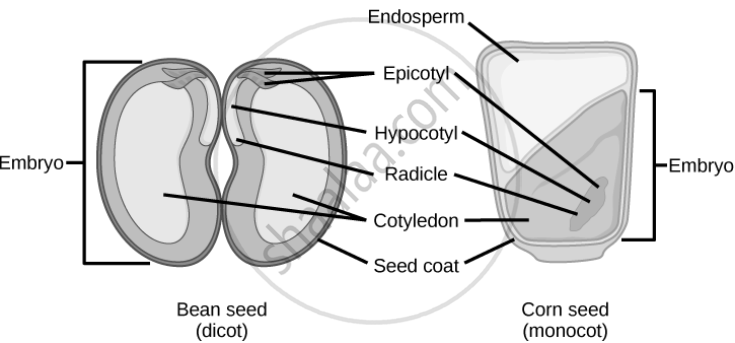
Dicot vs. Monocot Seeds
| Feature | Dicotyledonous Seed | Monocotyledonous Seed |
|---|---|---|
| No. of Cotyledons | Two | One (called Scutellum) |
| Endosperm in Mature Seed | Absent - fully absorbed (non-endospermic) | Present, bulky - Endospermic |
| Food Storage Site | Cotyledons store food directly | Endosperm stores food; scutellum absorbs it |
| Plumule Covering | Absent | Coleoptile (protective sheath) |
| Radicle Covering | Absent | Coleorhiza (protective sheath) |
| Aleurone Layer | Absent | Present - protein-rich outer layer of endosperm |
| Examples | Pea, Gram, Bean, Groundnut | Maize, Wheat, Rice, Barley |
Maharashtra State Board: Class 12
CISCE: Class 12
Endospermic vs. Non-Endospermic Seeds
| Type | Description | Examples |
|---|---|---|
| Endospermic (Albuminous) | Endosperm persists in mature seed - NOT fully consumed during embryo development | Wheat, Maize, Barley, Castor, Coconut |
| Non-Endospermic (Ex-albuminous) | Endosperm fully consumed; cotyledons absorb and store the food | Pea, Bean, Gram, Groundnut |
Maharashtra State Board: Class 12
CISCE: Class 12
External Features
- The seed remains attached to the placenta via a stalk-like structure called the funicle.
- When detached, the point of attachment leaves a scar called the hilum.
- In some seeds, a bright-coloured outgrowth develops on the surface called the aril.
| Outgrowth | Location | Term | Example |
|---|---|---|---|
| Aril from funicle | Outgrowth of funicle | Strophiole | Acacia, Pithecolobium |
| Aril around micropyle | Around micropyle opening | Caruncle | Ricinus (Castor) |
| Prominent Aril (edible) | Surrounds entire seed | Aril (edible part) | Litchi - fleshy edible part is the aril |
Maharashtra State Board: Class 12
CISCE: Class 12
Variation in Seeds
Seeds show remarkable variation in size, shape, colour and surface. Some plants can even be identified on the basis of seeds alone.
| Seed | Weight / Size | Notable Fact |
|---|---|---|
| Orchid | 20.33 micrograms | Smallest known seed in the world |
| Double Coconut (Lodoicea maldivica) | ~6 kg | Largest known seed in the world |
Maharashtra State Board: Class 12
CISCE: Class 12
Structure of Some Common Seeds
A. External Structure
| Feature | Dicot Seed - Bean (Phaseolus vulgaris) | Monocot Seed - Maize (Zea mays) |
|---|---|---|
| Outermost covering | Seed coat (two distinct layers) | Pericarp + seed coat fused (inseparable) |
| Outer layer | Testa - thick, leathery | Part of fused pericarp-seed coat |
| Inner layer | Tegmen - thin, papery | Part of fused pericarp-seed coat |
| Hilum | Large, oval scar; attachment point of funicle | Not distinctly visible (fused with fruit wall) |
| Micropyle | Small pore just above hilum; absorbs water during germination | Not separately distinguishable |
| Raphe | Ridge formed by funicle fused to integument | Absent |
| Shape | Kidney-shaped | Broad at top, tapering at base |
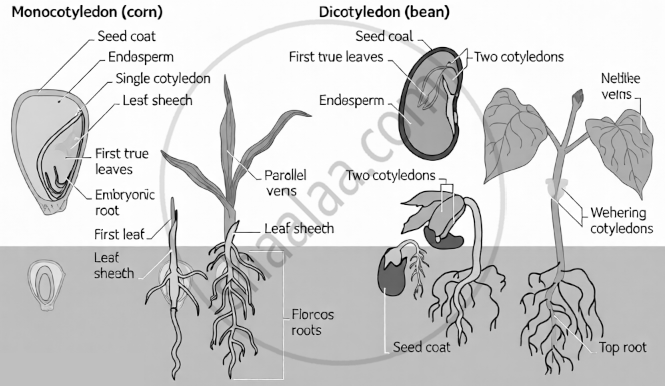
B. Internal Structure
| Feature | Dicot Seed - Bean (Phaseolus vulgaris) | Monocot Seed - Maize (Zea mays) |
|---|---|---|
| Endosperm | Absent at maturity (fully consumed during development) | Present - large, bulky, starchy; triploid (3n) |
| Aleurone layer | Absent | Present - outermost layer of endosperm; cells rich in protein (aleurone grains) |
| Cotyledons | Two (2) - large, thick, fleshy | One (Scutellum) - single, shield-shaped; lies adjacent to endosperm; functions as absorptive organ |
| Food storage site | Cotyledons | Endosperm |
| Embryonal axis | Present - short | Present - embedded on one side toward lower end of grain |
| Epicotyl | Portion above cotyledons; terminates in plumule | Part of embryonal axis |
| Hypocotyl | Portion below cotyledons; terminates in radicle | Part of embryonal axis |
| Plumule protection | No protective sheath | Enclosed by hollow sheath - Coleoptile |
| Radicle protection | No protective sheath | Enclosed by sheath - Coleorhiza |
| Seed type | Non-albuminous / Ex-albuminous | Albuminous / Endospermic |
Maharashtra State Board: Class 12
CISCE: Class 12
Definition: Dormancy
A state of metabolic inactivity in mature seeds where germination does not occur even under seemingly favourable conditions.
Maharashtra State Board: Class 12
CISCE: Class 12
Seed Dormancy & Viability
Seed Dormancy: A physiological state in which a viable seed fails to germinate even under favourable conditions of water, temperature, and oxygen. It is an adaptive mechanism for survival.
Seed Viability: The ability of a seed to germinate under appropriate conditions. It indicates whether a seed is alive or metabolically active.
Conditions for Germination:
Seeds require the following to break dormancy and germinate:
- Adequate water (seeds typically contain 10–15% water in the dormant state)
- Suitable temperature
- Adequate oxygen supply
- Sometimes: exposure to light (photoblastic seeds)
Seed Viability Records:
| Species | Viability Period | Significance |
|---|---|---|
| Lupinus arcticus (Arctic Lupin) | ~10,000 years | Longest recorded seed viability |
| Phoenix dactylifera (Date Palm) | ~2,000 years | Seeds from archaeological sites germinated |
| Most crop seeds | 2–15 years | Practical agricultural viability |
Maharashtra State Board: Class 12
CISCE: Class 12
True Fruit, False Fruit & Parthenocarpic Fruit
As ovules mature into seeds, the ovary simultaneously develops into a fruit. The ovary wall becomes the pericarp (fruit wall = epicarp + mesocarp + endocarp).
| Type | How it Forms | Fertilisation Required? | Examples |
|---|---|---|---|
| True Fruit | Develops only from the ovary | Yes | Mango, Tomato, Grapes |
| False Fruit (Pseudocarp) | Thalamus or other floral parts also contribute to fruit formation | Yes | Apple, Strawberry, Cashew (peduncle) |
| Parthenocarpic Fruit | Develops without fertilisation - seedless fruit | No | Banana, Seedless Watermelon |
Maharashtra State Board: Class 12
CISCE: Class 12
Advantages of Seeds to Angiosperms
- Seeds make reproduction independent of water, unlike lower plants such as mosses and ferns.
- Seeds can disperse to new places through wind, water, animals, and other methods.
- Stored food in seeds nourishes the young seedling during early growth.
- The seed coat protects the embryo from injury, drought, heat, and diseases.
- Seeds produce genetic variation, which helps in adaptation and evolution.
- Seeds can remain dormant during unfavourable conditions and germinate when conditions become suitable.
- Seeds of many plants are important sources of food, oils, fibres, spices, and other useful products.
Maharashtra State Board: Class 12
CISCE: Class 12
Key Points: The Seed
- A seed is a fertilised, mature ovule with an embryo, stored food (endosperm), and a protective seed coat (outer testa, inner tegmen).
- The embryo consists of the radicle (→ root), plumule (→ shoot), embryonal axis, and cotyledons (one in monocots, two in dicots); endosperm is triploid (3n).
- Dicot seeds have two cotyledons and store food in them (pea, bean); monocot seeds have one cotyledon (scutellum), a bulky endosperm, and a coleoptile and coleorhiza (maize, wheat).
- Albuminous seeds retain the endosperm (wheat, castor); ex-albuminous seeds store food in cotyledons (pea, groundnut).
- The seed attaches by a funicle, leaving a hilum, with a micropyle above it for water entry.
- Seed dormancy is the failure of a viable seed to germinate even in favourable conditions; germination needs water, suitable temperature, and oxygen.
- True fruits form only from the ovary (mango); false fruits include other floral parts (apple); parthenocarpic fruits are seedless and form without fertilisation (banana).
