Advertisements
Advertisements
Question
The breakdown in a reverse biased p–n junction diode is more likely to occur due to ______.
- large velocity of the minority charge carriers if the doping concentration is small.
- large velocity of the minority charge carriers if the doping concentration is large.
- strong electric field in a depletion region if the doping concentration is small.
- strong electric field in the depletion region if the doping concentration is large.
Options
a and d
b and d
c and d
b and c
Advertisements
Solution
a and d
Explanation:
Reverse biasing: Positive terminal of the battery is connected to the N-crystal and negative terminal of the battery is connected to P-crystal.
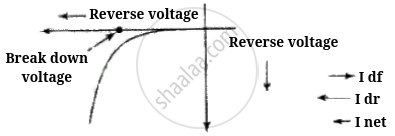
(i) In reverse biasing width of the depletion layer increases
(ii) In reverse biasing resistance offered `R_("Reverse")` = 105 Ω
(iii) Reverse bias supports the potential barrier and no current flows across the junction due to the diffusion of the majority carriers.
(A very small reverse current may exist in the circuit due to the drifting of minority carriers across the junction)
(iv) Break down voltage: Reverse voltage at which break down of semiconductor occurs. For Ge, it is 25 V and for Si, it is 35 V.
So, we conclude that in reverse biasing, ionization takes place because the minority charge carriers will be accelerated due to reverse biasing and striking with atoms which in turn cause secondary electrons and thus more charge carriers.
When doping concentration is large, there will be a large number of ions in the depletion region, which will give rise to a strong electric field.
APPEARS IN
RELATED QUESTIONS
With the help of neat labelled circuit diagram explain the working of half wave rectifier using semiconductor diode. Draw the input and output waveforms.
Explain the working of P-N junction diode in forward and reverse biased mode.
When a forward bias is applied to a p-n junction, it ______.
Draw its I – V characteristics of photodiode
In a photo diode, the conductive increases when the material is exposed to light. It is found that the conductivity changes only if the wavelength is less than 620 nm. What is the band gap?
(Use Planck constant h = 4.14 × 10⁻¹⁵ eV-s, Boltzmann constant k = 8·62 × 10-5 eV/K.)
A plate current of 10 mA is obtained when 60 volts are applied across a diode tube. Assuming the Langmuir-Child relation \[i_p \infty V_p^{3/2}\] to hold, find the dynamic resistance rp in this operating condition.
With reference to a semiconductor diode, what is meant by:
(i) Forward bias
(ii) Reverse bias
(iii) Depletion region
Diffusion in a p-n junction is due to ______.
What are the applications of p - n Junction diode?
The drift current in a p-n junction is from the ______.
Use a transistor as an amplition
On increasing the reverse biases voltage to a large value in a P – N junction diode-current
In Figure, Vo is the potential barrier across a p-n junction, when no battery is connected across the junction ______.

In the circuit shown in figure, if the diode forward voltage drop is 0.3 V, the voltage difference between A and B is ______.

Figure shows the transfer characteristics of a base biased CE transistor. Which of the following statements are true?

At Vi = 0.4 V, transistor is in active state.
At Vi = 1 V, it can be used as an amplifier.
At Vi = 0.5 V, it can be used as a switch turned off.
At Vi = 2.5 V, it can be used as a switch turned on.
In the depletion region of a diode ______.
- there are no mobile charges.
- equal number of holes and electrons exist, making the region neutral.
- recombination of holes and electrons has taken place.
- immobile charged ions exist.
Can the potential barrier across a p-n junction be measured by simply connecting a voltmeter across the junction?
Write the property of a junction diode which makes it suitable for rectification of ac voltages.
Describe the following term briefly:
minority carrier injection in forward biasing.
