Advertisements
Advertisements
Question
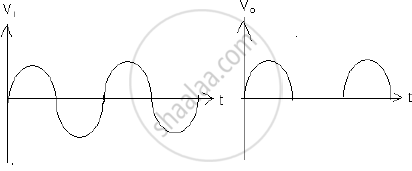
With the help of neat labelled circuit diagram explain the working of half wave rectifier using semiconductor diode. Draw the input and output waveforms.
Advertisements
Solution
A device which converts A.C. to D.C. is called rectifier. In this case output exists only for half cycle hence it is called half wave rectifier. Construction: The circuit diagram of a half wave rectifier using a junctiondiode is as shown in fig. The alternating voltage source is connected to the primary coil of a transformer. The secondary coil is connected to the diode in series with a resistance RL called the load resistance
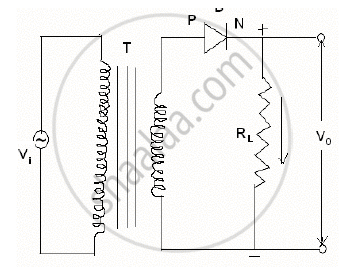
T=Transformer
D=Diode
V0=output voltage
v1=input votage
RL=load resistance
Working: In first cycle of input voltage, the anode of the diode is positive potential w.r.t. cathode. Hence the diode is in forward-biased. Hence it conduct current. The current flows through load resistance giving voltage drop iRL. This voltage drop is called output voltage. During next half cycle the anode of diode is in negative potential w.r.t. Hence it is in reversed-biased. Hence it does not conduct the current. Hence current does not flow through load resistance giving no P.D. across it. Hence output voltage is unidirectional. It is called as D.C.
APPEARS IN
RELATED QUESTIONS
When a forward bias is applied to a p-n junction, it ______.
Draw its I – V characteristics of photodiode
With reference to semiconductor devices, define a p-type semiconductor and a Zener diode.
What is the use of Zener diode?
Draw a labelled diagram of a full wave rectifier. Show how output voltage varies with time if the input voltage is a sinusoidal voltage.
Show on a graph, the variation of resistivity with temperature for a typical semiconductor.
Why is a zener diode considered as a special purpose semiconductor diode?
The gain factor of an amplifier in increased from 10 to 12 as the load resistance is changed from 4 kΩ to 8 kΩ. Calculate (a) the amplification factor and (b) the plate resistance.
In semiconductor physics, what is meant by:
(i) rectifier
(ii) an amplifier
(iii) an oscillator
A – pn junction has a depletion layer of thickness .of the order of
The nature of binding for a crystal with alternate and evenly spaced positive and negatively ions is
Use a transistor as an amplition
In a semiconductor diode, the barrier potential offers opposition to only
Consider an npn transistor with its base-emitter junction forward biased and collector base junction reverse biased. Which of the following statements are true?
- Electrons crossover from emitter to collector.
- Holes move from base to collector.
- Electrons move from emitter to base.
- Electrons from emitter move out of base without going to the collector.
Consider an npn transistor with its base-emitter junction forward biased and collector base junction reverse biased. Which of the following statements are true?
- Electrons crossover from emitter to collector.
- Holes move from base to collector.
- Electrons move from emitter to base.
- Electrons from emitter move out of base without going to the collector.
In the depletion region of a diode ______.
- there are no mobile charges.
- equal number of holes and electrons exist, making the region neutral.
- recombination of holes and electrons has taken place.
- immobile charged ions exist.
Can the potential barrier across a p-n junction be measured by simply connecting a voltmeter across the junction?
Consider a box with three terminals on top of it as shown in figure (a):
 (a) |
Three components namely, two germanium diodes and one resistor are connected across these three terminals in some arrangement. A student performs an experiment in which any two of these three terminals are connected in the circuit shown in figure (b).
 (b) |
The student obtains graphs of current-voltage characteristics for unknown combination of components between the two terminals connected in the circuit. The graphs are
(i) when A is positive and B is negative
 (c) |
(ii) when A is negative and B is positive
 (d) |
(iii) When B is negative and C is positive
|
(e) |

(iv) When B is positive and C is negative
 (f) |
(v) When A is positive and C is negative
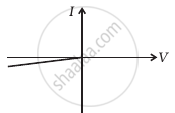 (g) |
(vi) When A is negative and C is positive
 (h) |
From these graphs of current-voltage characteristics shown in figure (c) to (h), determine the arrangement of components between A, B and C.
Answer the following giving reasons:
A p-n junction diode is damaged by a strong current.
A semiconductor device is connected in series with a battery, an ammeter and a resistor. A current flows in the circuit. If. the polarity of the battery is reversed, the current in the circuit almost becomes zero. The device is a/an ______.
Draw a labelled characteristic curve (l-V graph) for a semiconductor diode during forward bias.
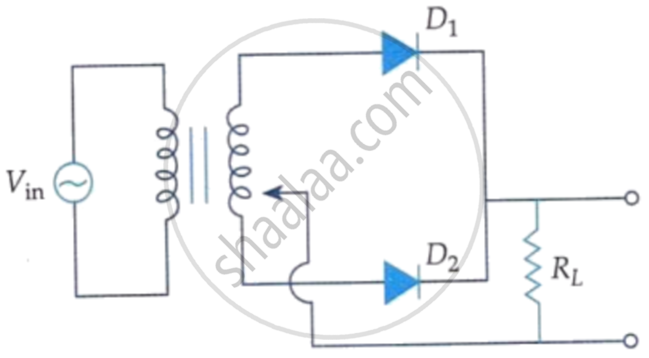
A full wave rectifier circuit diodes (D1) and (D2) is shown in the figure. If input supply voltage Vin = 220 sin (100 πt) volt, then at t = 15 ms.
Choose the correct circuit which can achieve the bridge balance.
Which charge carriers are present in large numbers in an n-type semiconductor?
When the p-side and n-side are joined, in which direction do holes diffuse?
What is the V-I characteristic curve of a diode?
What does the comparison of \[10\,\Omega\] in forward bias and \[1.0\times10^{7}\,\Omega\] in reverse bias show?
