Advertisements
Advertisements
Question
Consider a box with three terminals on top of it as shown in figure (a):
 (a) |
Three components namely, two germanium diodes and one resistor are connected across these three terminals in some arrangement. A student performs an experiment in which any two of these three terminals are connected in the circuit shown in figure (b).
 (b) |
The student obtains graphs of current-voltage characteristics for unknown combination of components between the two terminals connected in the circuit. The graphs are
(i) when A is positive and B is negative
 (c) |
(ii) when A is negative and B is positive
 (d) |
(iii) When B is negative and C is positive
|
(e) |

(iv) When B is positive and C is negative
 (f) |
(v) When A is positive and C is negative
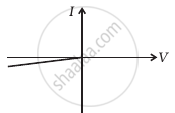 (g) |
(vi) When A is negative and C is positive
 (h) |
From these graphs of current-voltage characteristics shown in figure (c) to (h), determine the arrangement of components between A, B and C.
Advertisements
Solution
The V-I characteristics of these graphs are discussed in points:
(a) In the V-I graph of condition (i), reverse characteristics are shown in figure (c). Here A is connected to the n-side of p-n junction I and B is connected top-side of the p-n junction I with a resistance in series.
(b) In the V-I graph of condition (ii), a forward characteristic is shown in figure (d), where 0.7 V is the knee voltage of p-n junction I. 1/slope = (1/1000) Ω.
It means A is connected to the n-side of p-n junction I and B is connected to the p-side of p-n junction I and resistance R is in a series of p-n junction I between A and B.
(c) In the V-I graph of condition (iii), a forward characteristic is shown in figure (e), where 0.7 V is the knee voltage. In this case, p-side of p-n junction II is connected to C and the n-side of p-n junction II to B.
(d) In V-I graphs of conditions (iv), (v), (vi) also concludes the above connection of p-n junctions I and II along with a resistance R.
Thus, the arrangement of p-n I, p-n II and resistance R between A, B and C will be as shown in the figure.

APPEARS IN
RELATED QUESTIONS
Explain the working of P-N junction diode in forward and reverse biased mode.
With reference to semi-conductors answer the following :
(i) What is the change in the resistance of the semi-conductor with increase in temperature ?
(ii) Name the majority charge carriers in n-type semi-conductor.
(iii) What is meant by doping ?
The power delivered in the plate circular of a diode is 1.0 W when the plate voltage is 36 V. Find the power delivered if the plate voltage is increased to 49 V. Assume Langmuir-Child equation to hold.
Answer the following question.
Why photodiodes are required to operate in reverse bias? Explain.
What are the applications of p - n Junction diode?
The current through an ideal PN-junction shown in the following circuit diagram will be:

The drift current in a p-n junction is from the ______.
When we apply reverse biased to a junction diode, it
The nature of binding for a crystal with alternate and evenly spaced positive and negatively ions is
Use a transistor as an amplition
The expected energy of the electron at absolute zero is called:-
In the circuit shown in figure, if the diode forward voltage drop is 0.3 V, the voltage difference between A and B is ______.

When an electric field is applied across a semiconductor ______.
- electrons move from lower energy level to higher energy level in the conduction band.
- electrons move from higher energy level to lower energy level in the conduction band.
- holes in the valence band move from higher energy level to lower energy level.
- holes in the valence band move from lower energy level to higher energy level.
In the circuit shown in figure, when the input voltage of the base resistance is 10 V, Vbe is zero and Vce is also zero. Find the values of Ib, Ic and β.

Differentiate between the threshold voltage and the breakdown voltage for a diode.
Draw the circuit arrangement for studying V-I characteristics of a p-n junction diode in (i) forward biasing and (ii) reverse biasing. Draw the typical V-I characteristics of a silicon diode.
Describe the following term briefly:
Breakdown voltage in reverse biasing
What is meant by forward biasing of a semiconductor diode?
Choose the correct circuit which can achieve the bridge balance.
