Advertisements
Advertisements
Question
If each diode in figure has a forward bias resistance of 25 Ω and infinite resistance in reverse bias, what will be the values of the current I1, I2, I3 and I4?

Advertisements
Solution
According to the problem, forward biased resistance = 25 Ω and reverse biased resistance = ∞
As shown in the figure, the diode in branch CD is in reverse biased which has infinite resistance.
So, the current in that branch is zero, i.e. I3, = 0
Resistance in branch AB = 25 + 125 = 150 Ω say R1
Resistance in branch EF = 25 + 125 = 150 Ω, say R2
AB is parallel to EF
So, effective resistance
`1/R^' = 1/R_1 + 1/R_2 = 1/150 + 1/150 = 2/150`
⇒ R' 75 Ω
Total resistance R of the circuit = R' + 25 = 75 + 25 = 100 Ω
Current `I_1 = V/R = 5/100` = 0.05 A
According to Kirchhoff's, current law (KCL),
I1 = I4 + I2 + I3 .....(Here I3 = 0)
So I1 = I4 + I2
Here, the resistance R1 and R2 are same.
i.e., I4 = I2
∴ I1 = 2I2
⇒ `I_2 = I_1/2 = 0.05/2` = 0.025 A
And I4 = 0.025 A
Therefore, we get, I1 = 0.05 A, I2 = 0.025 A, I3 = 0 and I4 = 0.025 A.
APPEARS IN
RELATED QUESTIONS
With the help of neat labelled circuit diagram explain the working of half wave rectifier using semiconductor diode. Draw the input and output waveforms.
Explain the working of P-N junction diode in forward and reverse biased mode.
In the following diagram, is the junction diode forward biased or reverse biased ?
With reference to semiconductor devices, define a p-type semiconductor and a Zener diode.
The power delivered in the plate circular of a diode is 1.0 W when the plate voltage is 36 V. Find the power delivered if the plate voltage is increased to 49 V. Assume Langmuir-Child equation to hold.
A triode value operates at Vp = 225 V and Vg = −0.5 V.
The plate current remains unchanged if the plate voltage is increased to 250 V and the grid voltage is decreased to −2.5 V. Calculate the amplification factor.
We use alloys for making standard resistors because they have ____________.
When we apply reverse biased to a junction diode, it
In forward bias width of potential barrier in a p + n junction diode
In Figure, Vo is the potential barrier across a p-n junction, when no battery is connected across the junction ______.

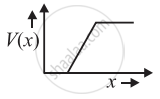
The graph of potential barrier versus width of depletion region for an unbiased diode is shown in graph A. In comparison to A, graphs B and C are obtained after biasing the diode in different ways. Identify the type of biasing in B and C and justify your answer
| ‘A’ | ‘B’ | ‘C’ |
 |
 |
 |
A semiconductor device is connected in series with a battery, an ammeter and a resistor. A current flows in the circuit. If. the polarity of the battery is reversed, the current in the circuit almost becomes zero. The device is a/an ______.
What is meant by forward biasing of a semiconductor diode?
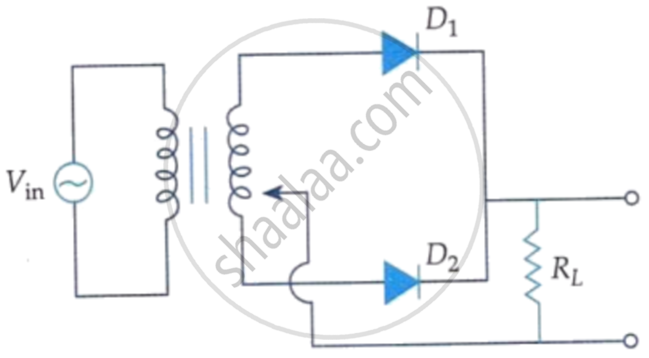
A full wave rectifier circuit diodes (D1) and (D2) is shown in the figure. If input supply voltage Vin = 220 sin (100 πt) volt, then at t = 15 ms.
When the p-side and n-side are joined, in which direction do holes diffuse?
What occurs near the junction when the p-side and n-side are joined?
What is the approximate cut-in voltage of a silicon diode?
How does effective resistance compare between forward bias after the cut-in voltage and reverse bias before breakdown?
Which voltage corresponds to a forward current of \[10\,\mathrm{mA}\]?
Which expression applies Ohm's law to reverse-biased resistance?
