Advertisements
Advertisements
Question
 (a) |
 (b) |
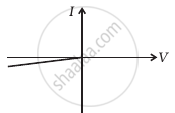
- Name the type of a diode whose characteristics are shown in figure (A) and figure (B).
- What does the point P in figure (A) represent?
- What does the points P and Q in figure (B) represent?
Advertisements
Solution
- Figure (a) represents the characteristics of the Zener diode and curve (b) is of the solar cell.
- In figure (a), point P represents Zener breakdown voltage.
- In figure (b), point Q represents zero voltage and negative current. This means the light falling on the solar cell with at least a minimum threshold frequency gives the current in opposite direction to that due to a battery connected to solar cell. But for point Q the battery is short-circuited. Hence it represents the short circuit current. And the point Pin fig. (b) represents some open circuit, the voltage on solar cell with zero current through solar cell.
It means, there is a battery connected to a solar cell which gives rise to the equal and opposite current to that in a solar cell by virtue of light falling on it.
APPEARS IN
RELATED QUESTIONS
In the following diagram, is the junction diode forward biased or reverse biased ?
With reference to semiconductor devices, define a p-type semiconductor and a Zener diode.
Draw a labelled diagram of a full wave rectifier. Show how output voltage varies with time if the input voltage is a sinusoidal voltage.
Plot a graph showing variation of current versus voltage for the material GaAs ?
The graph shown in the figure represents a plot of current versus voltage for a given semiconductor. Identify the region, if any, over which the semiconductor has a negative resistance.

Why is a zener diode considered as a special purpose semiconductor diode?
With reference to semi-conductors answer the following :
(i) What is the change in the resistance of the semi-conductor with increase in temperature ?
(ii) Name the majority charge carriers in n-type semi-conductor.
(iii) What is meant by doping ?
With reference to a semiconductor diode, what is meant by:
(i) Forward bias
(ii) Reverse bias
(iii) Depletion region
Basic materials used in the present solid state electronic devices like diode, transistor, ICs, etc are ______.
Use a transistor as an amplition
If each diode in figure has a forward bias resistance of 25 Ω and infinite resistance in reverse bias, what will be the values of the current I1, I2, I3 and I4?

Consider a box with three terminals on top of it as shown in figure (a):
 (a) |
Three components namely, two germanium diodes and one resistor are connected across these three terminals in some arrangement. A student performs an experiment in which any two of these three terminals are connected in the circuit shown in figure (b).
 (b) |
The student obtains graphs of current-voltage characteristics for unknown combination of components between the two terminals connected in the circuit. The graphs are
(i) when A is positive and B is negative
 (c) |
(ii) when A is negative and B is positive
 (d) |
(iii) When B is negative and C is positive
|
(e) |

(iv) When B is positive and C is negative
 (f) |
(v) When A is positive and C is negative
 (g) |
(vi) When A is negative and C is positive
 (h) |
From these graphs of current-voltage characteristics shown in figure (c) to (h), determine the arrangement of components between A, B and C.
Explain the formation of the barrier potential in a p-n junction.
Answer the following giving reasons:
A p-n junction diode is damaged by a strong current.
With reference to a semiconductor diode, define the depletion region.
An ideal PN junction diode offers ______.
What opposes further diffusion in the depletion layer?
Which formula gives the forward dynamic (AC) resistance?
