Advertisements
Advertisements
Question
In the circuit shown in figure, when the input voltage of the base resistance is 10 V, Vbe is zero and Vce is also zero. Find the values of Ib, Ic and β.

Advertisements
Solution
According to the problem, Vi = 10 V, Resistance, RB = 400 kΩ, VBE = 0, VCE = 0 and RC = 3 kΩ
`V_i - V_(BE) = R_BI_B`
`I_B = ("Voltage across" R_B)/R_B`
= `10/(400 xx 10^3)`
= `25 xx 10^-6` A
= 25 μA
Voltage across RC = 10 V
`V_(CC) - V_(CE) = I_CR_C`
`I_C = ("Voltage across" R_C)/R_C`
= `10/(3 xx 10^3)`
= `3.33 xx 10^-3` A
= 3.33 mA
β = `I_C/I_B`
= `(3.33 xx 10^-3)/(25 xx 10^-6)`
= `1.33 xx 10^2`
= 133
APPEARS IN
RELATED QUESTIONS
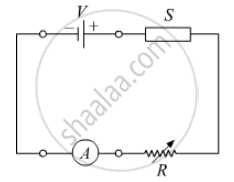
In the following diagram 'S' is a semiconductor. Would you increase or decrease the value of R to keep the reading of the ammeter A constant when S is heated? Give reason for your answer.
Draw its I – V characteristics of photodiode
With reference to semiconductor devices, define a p-type semiconductor and a Zener diode.
In a photo diode, the conductive increases when the material is exposed to light. It is found that the conductivity changes only if the wavelength is less than 620 nm. What is the band gap?
(Use Planck constant h = 4.14 × 10⁻¹⁵ eV-s, Boltzmann constant k = 8·62 × 10-5 eV/K.)
With reference to semi-conductors answer the following :
(i) What is the change in the resistance of the semi-conductor with increase in temperature ?
(ii) Name the majority charge carriers in n-type semi-conductor.
(iii) What is meant by doping ?
The power delivered in the plate circular of a diode is 1.0 W when the plate voltage is 36 V. Find the power delivered if the plate voltage is increased to 49 V. Assume Langmuir-Child equation to hold.
The dynamic plate resistance of a triode value is 10 kΩ. Find the change in the plate current if the plate voltage is changed from 200 V to 220 V.
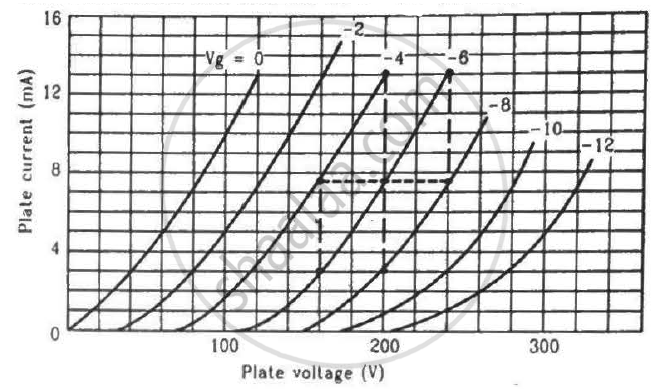
Find the values of rp, µ and gm of a triode operating at plate voltage 200 V and grid voltage −6. The plate characteristics are shown in the figure.
What are the applications of p - n Junction diode?
In forward bias width of potential barrier in a p + n junction diode
When an electric field is applied across a semiconductor ______.
- electrons move from lower energy level to higher energy level in the conduction band.
- electrons move from higher energy level to lower energy level in the conduction band.
- holes in the valence band move from higher energy level to lower energy level.
- holes in the valence band move from lower energy level to higher energy level.
 (a) |
 (b) |
- Name the type of a diode whose characteristics are shown in figure (A) and figure (B).
- What does the point P in figure (A) represent?
- What does the points P and Q in figure (B) represent?
Write the property of a junction diode which makes it suitable for rectification of ac voltages.
Describe the following term briefly:
Breakdown voltage in reverse biasing
Draw a labelled characteristic curve (l-V graph) for a semiconductor diode during forward bias.
Which charge carriers are present in large numbers in an n-type semiconductor?
What occurs near the junction when the p-side and n-side are joined?
What happens to reverse current at the breakdown voltage?
Which voltage corresponds to a forward current of \[10\,\mathrm{mA}\]?
