Advertisements
Advertisements
प्रश्न
In the circuit shown in figure, when the input voltage of the base resistance is 10 V, Vbe is zero and Vce is also zero. Find the values of Ib, Ic and β.

Advertisements
उत्तर
According to the problem, Vi = 10 V, Resistance, RB = 400 kΩ, VBE = 0, VCE = 0 and RC = 3 kΩ
`V_i - V_(BE) = R_BI_B`
`I_B = ("Voltage across" R_B)/R_B`
= `10/(400 xx 10^3)`
= `25 xx 10^-6` A
= 25 μA
Voltage across RC = 10 V
`V_(CC) - V_(CE) = I_CR_C`
`I_C = ("Voltage across" R_C)/R_C`
= `10/(3 xx 10^3)`
= `3.33 xx 10^-3` A
= 3.33 mA
β = `I_C/I_B`
= `(3.33 xx 10^-3)/(25 xx 10^-6)`
= `1.33 xx 10^2`
= 133
APPEARS IN
संबंधित प्रश्न
In the following diagram, is the junction diode forward biased or reverse biased ?
With reference to semiconductor devices, define a p-type semiconductor and a Zener diode.
What is the use of Zener diode?
Why is a zener diode considered as a special purpose semiconductor diode?
A triode value operates at Vp = 225 V and Vg = −0.5 V.
The plate current remains unchanged if the plate voltage is increased to 250 V and the grid voltage is decreased to −2.5 V. Calculate the amplification factor.
With reference to Semiconductor Physics,
Name the diode that emits spontaneous radiation when forward biased.
When we apply reverse biased to a junction diode, it
The expected energy of the electron at absolute zero is called:-
Avalanche breakdown is due to ______.
Consider an npn transistor with its base-emitter junction forward biased and collector base junction reverse biased. Which of the following statements are true?
- Electrons crossover from emitter to collector.
- Holes move from base to collector.
- Electrons move from emitter to base.
- Electrons from emitter move out of base without going to the collector.
Figure shows the transfer characteristics of a base biased CE transistor. Which of the following statements are true?

At Vi = 0.4 V, transistor is in active state.
At Vi = 1 V, it can be used as an amplifier.
At Vi = 0.5 V, it can be used as a switch turned off.
At Vi = 2.5 V, it can be used as a switch turned on.
 (a) |
 (b) |
- Name the type of a diode whose characteristics are shown in figure (A) and figure (B).
- What does the point P in figure (A) represent?
- What does the points P and Q in figure (B) represent?
Explain the formation of the barrier potential in a p-n junction.
With reference to a semiconductor diode, define the potential barrier.
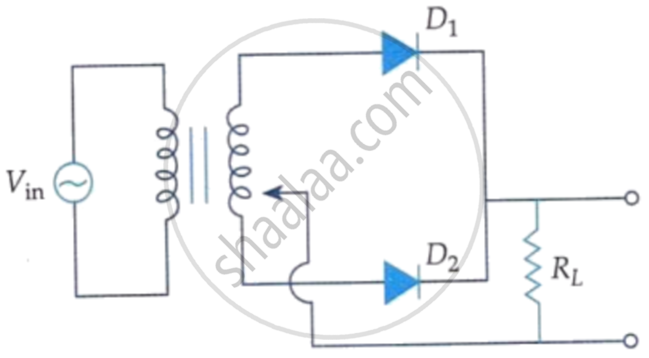
A full wave rectifier circuit diodes (D1) and (D2) is shown in the figure. If input supply voltage Vin = 220 sin (100 πt) volt, then at t = 15 ms.
What is the approximate cut-in voltage of a silicon diode?
What happens to reverse current at the breakdown voltage?
Which formula gives the forward dynamic (AC) resistance?
