Advertisements
Advertisements
प्रश्न
Can the potential barrier across a p-n junction be measured by simply connecting a voltmeter across the junction?
Advertisements
उत्तर
We cannot measure the potential barrier across a p-n junction by a voltmeter because the resistance of the voltmeter is very high compared to the junction resistance. Potential of potential barrier for Ge is VB = 0.3 V and for silicon is VB = 0.7 V.
On average the potential barrier in the P-N junction is ~0.5 V.
APPEARS IN
संबंधित प्रश्न
In the following diagram, is the junction diode forward biased or reverse biased ?
What is the use of Zener diode?
Draw a labelled diagram of a full wave rectifier. Show how output voltage varies with time if the input voltage is a sinusoidal voltage.
The plate current in a diode is 20 mA when the plate voltage is 50 V or 60 V. What will be the current if the plate voltage is 70 V?
A triode value operates at Vp = 225 V and Vg = −0.5 V.
The plate current remains unchanged if the plate voltage is increased to 250 V and the grid voltage is decreased to −2.5 V. Calculate the amplification factor.
With reference to Semiconductor Physics,
Name the diode that emits spontaneous radiation when forward biased.
Consider an npn transistor with its base-emitter junction forward biased and collector base junction reverse biased. Which of the following statements are true?
- Electrons crossover from emitter to collector.
- Holes move from base to collector.
- Electrons move from emitter to base.
- Electrons from emitter move out of base without going to the collector.
Consider an npn transistor with its base-emitter junction forward biased and collector base junction reverse biased. Which of the following statements are true?
- Electrons crossover from emitter to collector.
- Holes move from base to collector.
- Electrons move from emitter to base.
- Electrons from emitter move out of base without going to the collector.
The breakdown in a reverse biased p–n junction diode is more likely to occur due to ______.
- large velocity of the minority charge carriers if the doping concentration is small.
- large velocity of the minority charge carriers if the doping concentration is large.
- strong electric field in a depletion region if the doping concentration is small.
- strong electric field in the depletion region if the doping concentration is large.
A semiconductor device is connected in series with a battery, an ammeter and a resistor. A current flows in the circuit. If. the polarity of the battery is reversed, the current in the circuit almost becomes zero. The device is a/an ______.
Draw the circuit arrangement for studying V-I characteristics of a p-n junction diode in (i) forward biasing and (ii) reverse biasing. Draw the typical V-I characteristics of a silicon diode.
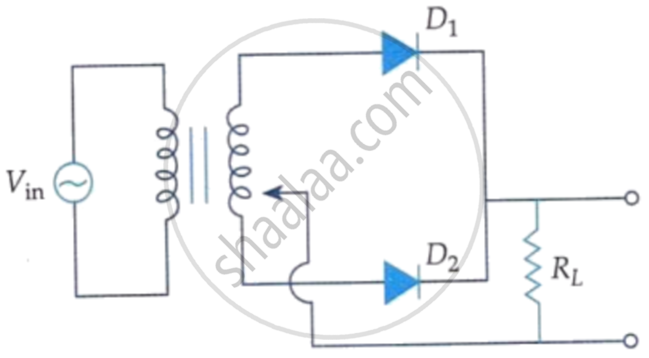
A full wave rectifier circuit diodes (D1) and (D2) is shown in the figure. If input supply voltage Vin = 220 sin (100 πt) volt, then at t = 15 ms.
When the p-side and n-side are joined, in which direction do electrons diffuse?
When the p-side and n-side are joined, in which direction do holes diffuse?
What is the approximate cut-in voltage of a germanium diode?
Which practical effect is associated with reverse bias before breakdown?
What is the V-I characteristic curve of a diode?
Which voltage corresponds to a forward current of \[10\,\mathrm{mA}\]?
Which expression applies Ohm's law to reverse-biased resistance?
What does the comparison of \[10\,\Omega\] in forward bias and \[1.0\times10^{7}\,\Omega\] in reverse bias show?
