Advertisements
Advertisements
प्रश्न
When an electric field is applied across a semiconductor ______.
- electrons move from lower energy level to higher energy level in the conduction band.
- electrons move from higher energy level to lower energy level in the conduction band.
- holes in the valence band move from higher energy level to lower energy level.
- holes in the valence band move from lower energy level to higher energy level.
पर्याय
a and b
b and c
d and a
a and c
Advertisements
उत्तर
a and c
Explanation:
In the valence band electrons are not capable of gaining energy from the external electric fields. While in the conduction band the electrons can gain energy from the external electric field.
When an electric field is applied across a semiconductor, the electrons in the conduction band (which is partially filled with electrons) get accelerated and acquire energy. They move from lower energy levels to higher energy levels. While the holes in the valence band move from higher energy level to lower energy level, where they will be having more energy.
APPEARS IN
संबंधित प्रश्न
Explain the working of P-N junction diode in forward and reverse biased mode.
Show on a graph, the variation of resistivity with temperature for a typical semiconductor.
In a photo diode, the conductive increases when the material is exposed to light. It is found that the conductivity changes only if the wavelength is less than 620 nm. What is the band gap?
(Use Planck constant h = 4.14 × 10⁻¹⁵ eV-s, Boltzmann constant k = 8·62 × 10-5 eV/K.)
A plate current of 10 mA is obtained when 60 volts are applied across a diode tube. Assuming the Langmuir-Child relation \[i_p \infty V_p^{3/2}\] to hold, find the dynamic resistance rp in this operating condition.
The plate current in a diode is 20 mA when the plate voltage is 50 V or 60 V. What will be the current if the plate voltage is 70 V?
Find the values of rp, µ and gm of a triode operating at plate voltage 200 V and grid voltage −6. The plate characteristics are shown in the figure.
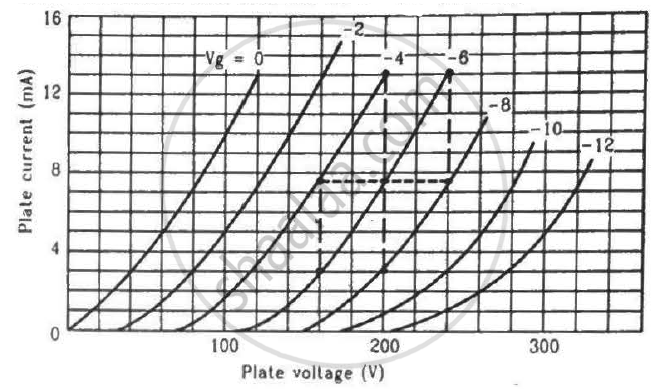
The gain factor of an amplifier in increased from 10 to 12 as the load resistance is changed from 4 kΩ to 8 kΩ. Calculate (a) the amplification factor and (b) the plate resistance.
Basic materials used in the present solid state electronic devices like diode, transistor, ICs, etc are ______.
With reference to Semiconductor Physics,
Name the diode that emits spontaneous radiation when forward biased.
In a semiconductor diode, the barrier potential offers opposition to only
In the circuit shown in figure, if the diode forward voltage drop is 0.3 V, the voltage difference between A and B is ______.

In the depletion region of a diode ______.
- there are no mobile charges.
- equal number of holes and electrons exist, making the region neutral.
- recombination of holes and electrons has taken place.
- immobile charged ions exist.
 (a) |
 (b) |
- Name the type of a diode whose characteristics are shown in figure (A) and figure (B).
- What does the point P in figure (A) represent?
- What does the points P and Q in figure (B) represent?
With reference to a semiconductor diode, define the depletion region.
When the p-side and n-side are joined, in which direction do electrons diffuse?
What is left behind near the junction, creating a depletion layer?
Which battery connection puts a diode in forward bias?
Which expression applies Ohm's law to reverse-biased resistance?
