Advertisements
Advertisements
प्रश्न
Consider an npn transistor with its base-emitter junction forward biased and collector base junction reverse biased. Which of the following statements are true?
- Electrons crossover from emitter to collector.
- Holes move from base to collector.
- Electrons move from emitter to base.
- Electrons from emitter move out of base without going to the collector.
पर्याय
d and a
a and b
b and c
a and c
Advertisements
उत्तर
a and c
Explanation:
Transistor: A junction transistor is formed by sandwiching 2 thin layer of P-type semiconductors between two N-type semiconductors. or by sandwiching a thin taver of V-type semiconductors between two P-type semiconductors.
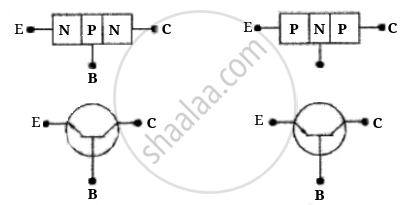
E — Emitter (emits majority charge carriers)
C — Collects majority charge carriers
B — Base (provide proper interaction between E and C)

In normal operation base-emitter is forward biased, i.e., the positive pole of the emitter-base battery is connected to the base and its negative pole is connected to the emitter. And collector-base junction is reverse biased, i.e., the positive pole of the collector base battery is connected to the collector and the negative pole to base. Thus, electron moves from emitter to base and crossovers from emitter to collector.
APPEARS IN
संबंधित प्रश्न
(i) Explain with the help of a diagram the formation of depletion region and barrier potential in a pn junction.
With the help of neat labelled circuit diagram explain the working of half wave rectifier using semiconductor diode. Draw the input and output waveforms.
In the following diagram, is the junction diode forward biased or reverse biased ?
What is the use of Zener diode?
The plate current in a diode is 20 mA when the plate voltage is 50 V or 60 V. What will be the current if the plate voltage is 70 V?
The dynamic plate resistance of a triode value is 10 kΩ. Find the change in the plate current if the plate voltage is changed from 200 V to 220 V.
The current through an ideal PN-junction shown in the following circuit diagram will be:

A – pn junction has a depletion layer of thickness .of the order of
When we apply reverse biased to a junction diode, it
The nature of binding for a crystal with alternate and evenly spaced positive and negatively ions is
On increasing the reverse biases voltage to a large value in a P – N junction diode-current
When an electric field is applied across a semiconductor ______.
- electrons move from lower energy level to higher energy level in the conduction band.
- electrons move from higher energy level to lower energy level in the conduction band.
- holes in the valence band move from higher energy level to lower energy level.
- holes in the valence band move from lower energy level to higher energy level.
Consider a box with three terminals on top of it as shown in figure (a):
 (a) |
Three components namely, two germanium diodes and one resistor are connected across these three terminals in some arrangement. A student performs an experiment in which any two of these three terminals are connected in the circuit shown in figure (b).
 (b) |
The student obtains graphs of current-voltage characteristics for unknown combination of components between the two terminals connected in the circuit. The graphs are
(i) when A is positive and B is negative
 (c) |
(ii) when A is negative and B is positive
 (d) |
(iii) When B is negative and C is positive
|
(e) |

(iv) When B is positive and C is negative
 (f) |
(v) When A is positive and C is negative
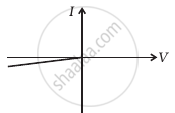 (g) |
(vi) When A is negative and C is positive
 (h) |
From these graphs of current-voltage characteristics shown in figure (c) to (h), determine the arrangement of components between A, B and C.
Draw the circuit arrangement for studying V-I characteristics of a p-n junction diode in (i) forward biasing and (ii) reverse biasing. Draw the typical V-I characteristics of a silicon diode.
Describe the following term briefly:
Breakdown voltage in reverse biasing
With reference to a semiconductor diode, define the depletion region.
What is the approximate cut-in voltage of a germanium diode?
Which voltage corresponds to a forward current of \[10\,\mathrm{mA}\]?
