Advertisements
Advertisements
प्रश्न
Draw the circuit arrangement for studying V-I characteristics of a p-n junction diode in (i) forward biasing and (ii) reverse biasing. Draw the typical V-I characteristics of a silicon diode.
Advertisements
उत्तर
Forward biasing:
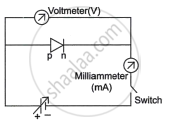
Fig. (a)
Reverse biasing:
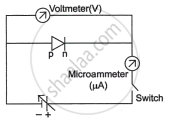
Fig. (b)

Fig. (c)
Figures (a) and (b) depict the circuit for examining a diode's V-I properties. The value of current is noted for various voltage values. The result is a graph between C and I, as shown in Fig. (c).
It is evident from a junction diode's V-I characteristics that current can only flow through it when it is forward biassed. As a result, when alternating voltage is placed across a forward biassed diode, current only flows during a portion of the cycle. Alternating voltages are rectified using this characteristic.
APPEARS IN
संबंधित प्रश्न
The current through an ideal PN-junction shown in the following circuit diagram will be:

When we apply reverse biased to a junction diode, it
On increasing the reverse biases voltage to a large value in a P – N junction diode-current
In Figure, Vo is the potential barrier across a p-n junction, when no battery is connected across the junction ______.

When an electric field is applied across a semiconductor ______.
- electrons move from lower energy level to higher energy level in the conduction band.
- electrons move from higher energy level to lower energy level in the conduction band.
- holes in the valence band move from higher energy level to lower energy level.
- holes in the valence band move from lower energy level to higher energy level.
In the depletion region of a diode ______.
- there are no mobile charges.
- equal number of holes and electrons exist, making the region neutral.
- recombination of holes and electrons has taken place.
- immobile charged ions exist.
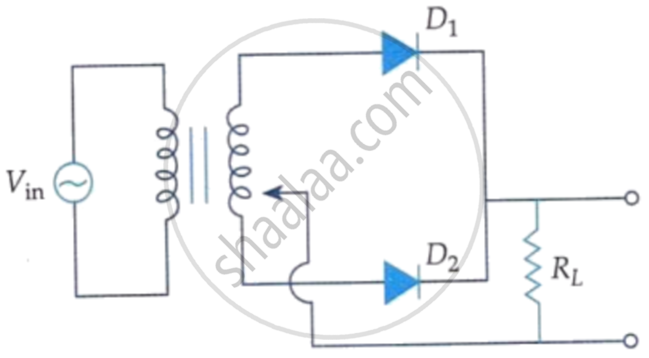
A full wave rectifier circuit diodes (D1) and (D2) is shown in the figure. If input supply voltage Vin = 220 sin (100 πt) volt, then at t = 15 ms.
Which practical effect is associated with forward bias?
What current flows in the reverse-bias V-I characteristic before breakdown?
Which formula gives the forward dynamic (AC) resistance?
