Advertisements
Advertisements
Question
Draw the circuit arrangement for studying V-I characteristics of a p-n junction diode in (i) forward biasing and (ii) reverse biasing. Draw the typical V-I characteristics of a silicon diode.
Advertisements
Solution
Forward biasing:
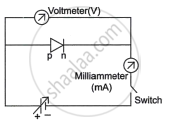
Fig. (a)
Reverse biasing:
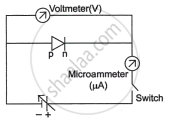
Fig. (b)

Fig. (c)
Figures (a) and (b) depict the circuit for examining a diode's V-I properties. The value of current is noted for various voltage values. The result is a graph between C and I, as shown in Fig. (c).
It is evident from a junction diode's V-I characteristics that current can only flow through it when it is forward biassed. As a result, when alternating voltage is placed across a forward biassed diode, current only flows during a portion of the cycle. Alternating voltages are rectified using this characteristic.
APPEARS IN
RELATED QUESTIONS
The plate current in a diode is 20 mA when the plate voltage is 50 V or 60 V. What will be the current if the plate voltage is 70 V?
Diffusion in a p-n junction is due to ______.
On increasing the reverse biases voltage to a large value in a P – N junction diode-current
When an electric field is applied across a semiconductor ______.
- electrons move from lower energy level to higher energy level in the conduction band.
- electrons move from higher energy level to lower energy level in the conduction band.
- holes in the valence band move from higher energy level to lower energy level.
- holes in the valence band move from lower energy level to higher energy level.
Consider an npn transistor with its base-emitter junction forward biased and collector base junction reverse biased. Which of the following statements are true?
- Electrons crossover from emitter to collector.
- Holes move from base to collector.
- Electrons move from emitter to base.
- Electrons from emitter move out of base without going to the collector.
Consider an npn transistor with its base-emitter junction forward biased and collector base junction reverse biased. Which of the following statements are true?
- Electrons crossover from emitter to collector.
- Holes move from base to collector.
- Electrons move from emitter to base.
- Electrons from emitter move out of base without going to the collector.
In the circuit shown in figure, when the input voltage of the base resistance is 10 V, Vbe is zero and Vce is also zero. Find the values of Ib, Ic and β.

Draw V-I characteristics of a p-n Junction diode.
A semiconductor device is connected in series with a battery, an ammeter and a resistor. A current flows in the circuit. If. the polarity of the battery is reversed, the current in the circuit almost becomes zero. The device is a/an ______.
With reference to a semiconductor diode, define the depletion region.
