Advertisements
Advertisements
प्रश्न
Consider an npn transistor with its base-emitter junction forward biased and collector base junction reverse biased. Which of the following statements are true?
- Electrons crossover from emitter to collector.
- Holes move from base to collector.
- Electrons move from emitter to base.
- Electrons from emitter move out of base without going to the collector.
विकल्प
d and a
a and b
b and c
a and c
Advertisements
उत्तर
a and c
Explanation:
Transistor: A junction transistor is formed by sandwiching 2 thin layer of P-type semiconductors between two N-type semiconductors. or by sandwiching a thin taver of V-type semiconductors between two P-type semiconductors.
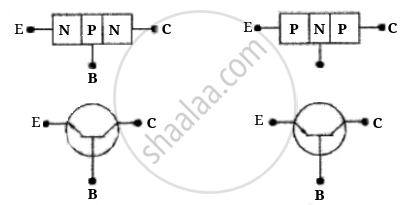
E — Emitter (emits majority charge carriers)
C — Collects majority charge carriers
B — Base (provide proper interaction between E and C)

In normal operation base-emitter is forward biased, i.e., the positive pole of the emitter-base battery is connected to the base and its negative pole is connected to the emitter. And collector-base junction is reverse biased, i.e., the positive pole of the collector base battery is connected to the collector and the negative pole to base. Thus, electron moves from emitter to base and crossovers from emitter to collector.
APPEARS IN
संबंधित प्रश्न
When a forward bias is applied to a p-n junction, it ______.
In the following diagram, is the junction diode forward biased or reverse biased ?
With reference to semiconductor devices, define a p-type semiconductor and a Zener diode.
Plot a graph showing variation of current versus voltage for the material GaAs ?
The gain factor of an amplifier in increased from 10 to 12 as the load resistance is changed from 4 kΩ to 8 kΩ. Calculate (a) the amplification factor and (b) the plate resistance.
With reference to a semiconductor diode, what is meant by:
(i) Forward bias
(ii) Reverse bias
(iii) Depletion region
We use alloys for making standard resistors because they have ____________.
With reference to Semiconductor Physics,
Name the diode that emits spontaneous radiation when forward biased.
In forward bias width of potential barrier in a p + n junction diode
On increasing the reverse biases voltage to a large value in a P – N junction diode-current
In Figure, Vo is the potential barrier across a p-n junction, when no battery is connected across the junction ______.

Figure shows the transfer characteristics of a base biased CE transistor. Which of the following statements are true?

At Vi = 0.4 V, transistor is in active state.
At Vi = 1 V, it can be used as an amplifier.
At Vi = 0.5 V, it can be used as a switch turned off.
At Vi = 2.5 V, it can be used as a switch turned on.
In the depletion region of a diode ______.
- there are no mobile charges.
- equal number of holes and electrons exist, making the region neutral.
- recombination of holes and electrons has taken place.
- immobile charged ions exist.
In the circuit shown in figure, when the input voltage of the base resistance is 10 V, Vbe is zero and Vce is also zero. Find the values of Ib, Ic and β.

Describe the following term briefly:
Breakdown voltage in reverse biasing
With reference to a semiconductor diode, define the potential barrier.
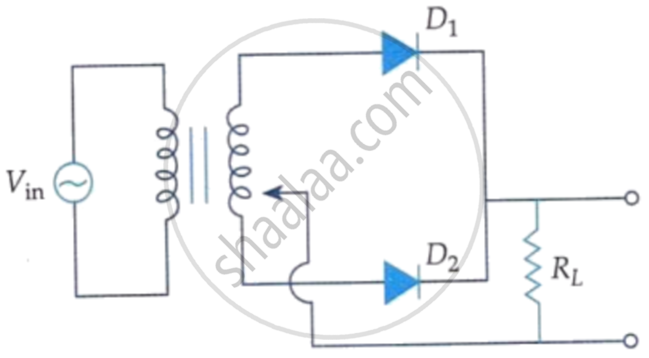
A full wave rectifier circuit diodes (D1) and (D2) is shown in the figure. If input supply voltage Vin = 220 sin (100 πt) volt, then at t = 15 ms.
What is the approximate cut-in voltage of a silicon diode?
How does effective resistance compare between forward bias after the cut-in voltage and reverse bias before breakdown?
