Advertisements
Advertisements
प्रश्न
Figure shows the transfer characteristics of a base biased CE transistor. Which of the following statements are true?

At Vi = 0.4 V, transistor is in active state.
At Vi = 1 V, it can be used as an amplifier.
At Vi = 0.5 V, it can be used as a switch turned off.
At Vi = 2.5 V, it can be used as a switch turned on.
विकल्प
a and c
a, c and d
b and c
b, c and d
Advertisements
उत्तर
b, c and d
Explanation:
According to the above graph transfer characteristics of a base biased common emitter transistor, we note that.
- When Vi= 0.4 V, the output voltage remain same and there is no collection current. So, the transistor circuit is not in an active state.
- When Vi = 1 V (This is in between 0.6 V to 2 V), the transistor circuit is in an active state and when input is increasing output is decreasing because when CE is used as an amplifier input and output voltages are 180° out of phase. Then it is used as an amplifier.
- When Vi = 0.5 V, there is no collector current. The transistor is in a cut-off state. The transistor circuit can be used as a switch to be turned off.
- When Vi = 2.5 V, the collector current becomes maximum and the transistor is in a saturation state and can be used as a switch turned on state.
APPEARS IN
संबंधित प्रश्न
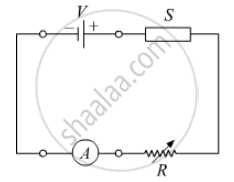
In the following diagram 'S' is a semiconductor. Would you increase or decrease the value of R to keep the reading of the ammeter A constant when S is heated? Give reason for your answer.
Draw its I – V characteristics of photodiode
What is the use of Zener diode?
Draw a labelled diagram of a full wave rectifier. Show how output voltage varies with time if the input voltage is a sinusoidal voltage.
Plot a graph showing variation of current versus voltage for the material GaAs ?
A triode value operates at Vp = 225 V and Vg = −0.5 V.
The plate current remains unchanged if the plate voltage is increased to 250 V and the grid voltage is decreased to −2.5 V. Calculate the amplification factor.
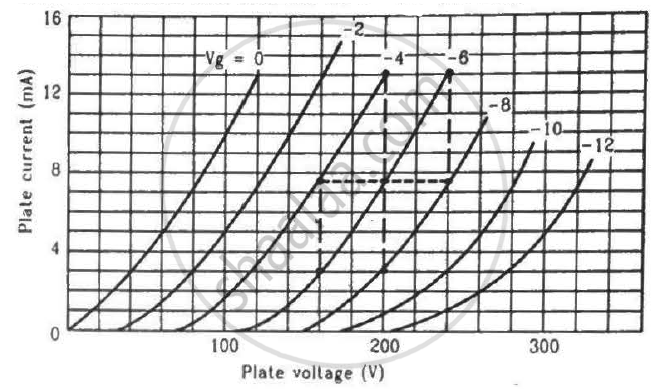
Find the values of rp, µ and gm of a triode operating at plate voltage 200 V and grid voltage −6. The plate characteristics are shown in the figure.
We use alloys for making standard resistors because they have ____________.
With reference to Semiconductor Physics,
Name the diode that emits spontaneous radiation when forward biased.
Of the diodes shown in the following diagrams, which one is reverse biased?
The expected energy of the electron at absolute zero is called:-
When an electric field is applied across a semiconductor ______.
- electrons move from lower energy level to higher energy level in the conduction band.
- electrons move from higher energy level to lower energy level in the conduction band.
- holes in the valence band move from higher energy level to lower energy level.
- holes in the valence band move from lower energy level to higher energy level.
Consider an npn transistor with its base-emitter junction forward biased and collector base junction reverse biased. Which of the following statements are true?
- Electrons crossover from emitter to collector.
- Holes move from base to collector.
- Electrons move from emitter to base.
- Electrons from emitter move out of base without going to the collector.
In the depletion region of a diode ______.
- there are no mobile charges.
- equal number of holes and electrons exist, making the region neutral.
- recombination of holes and electrons has taken place.
- immobile charged ions exist.
 (a) |
 (b) |
- Name the type of a diode whose characteristics are shown in figure (A) and figure (B).
- What does the point P in figure (A) represent?
- What does the points P and Q in figure (B) represent?
Explain the formation of the barrier potential in a p-n junction.
When the p-side and n-side are joined, in which direction do holes diffuse?
What opposes further diffusion in the depletion layer?
Which voltage corresponds to a forward current of \[10\,\mathrm{mA}\]?
Which expression applies Ohm's law to reverse-biased resistance?
