Advertisements
Advertisements
प्रश्न
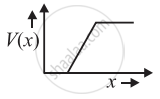
The graph of potential barrier versus width of depletion region for an unbiased diode is shown in graph A. In comparison to A, graphs B and C are obtained after biasing the diode in different ways. Identify the type of biasing in B and C and justify your answer
| ‘A’ | ‘B’ | ‘C’ |
 |
 |
 |
Advertisements
उत्तर
B - reverse biased
In the case of a reverse-biased diode, the potential barrier becomes higher as the battery further raises the potential of the n side.
C - forward biased
Due to the forward bias connection, the potential of P side is raised and hence the height of the potential barrier decreases.
APPEARS IN
संबंधित प्रश्न
(i) Explain with the help of a diagram the formation of depletion region and barrier potential in a pn junction.
When a forward bias is applied to a p-n junction, it ______.
Draw its I – V characteristics of photodiode
With reference to semiconductor devices, define a p-type semiconductor and a Zener diode.
Plot a graph showing variation of current versus voltage for the material GaAs ?
With reference to a semiconductor diode, what is meant by:
(i) Forward bias
(ii) Reverse bias
(iii) Depletion region
On increasing the reverse biases voltage to a large value in a P – N junction diode-current
 (a) |
 (b) |
- Name the type of a diode whose characteristics are shown in figure (A) and figure (B).
- What does the point P in figure (A) represent?
- What does the points P and Q in figure (B) represent?
When the p-side and n-side are joined, in which direction do holes diffuse?
Which battery connection puts a diode in forward bias?
