Advertisements
Advertisements
प्रश्न
The gain factor of an amplifier in increased from 10 to 12 as the load resistance is changed from 4 kΩ to 8 kΩ. Calculate (a) the amplification factor and (b) the plate resistance.
Advertisements
उत्तर
We know:-
Voltage gain = \[\frac{\mu}{1 + \frac{r_p}{R_L}} ............(1)\]
When voltage amplification factor, A = 10,
RL = 4 kΩ
\[10 = \frac{\mu}{1 + \frac{r_p}{4 \times {10}^3}}\]
\[\Rightarrow 10=\frac{\mu \times 4 \times {10}^3}{4 \times {10}^3 + r_p}\]
\[ \Rightarrow 4 \times {10}^4 + 10 r_P = 4000 \mu .........(2)\]
Now, increased gain, A = 12
Substituting this value in (1) ,we get:-
\[12 = \frac{\mu}{1 + \frac{r_P}{R_L}}\]
\[12 = \frac{\mu}{1 + \frac{r_p}{8 \times {10}^3}}\]
\[ \Rightarrow 12 = \frac{\mu \times 8000}{8000 + r_P}\]
\[ \Rightarrow 96000 + 12 r_P = 8000 \mu ...........(3)\]
On solving equations (2) and (3), we get:-
\[\mu = 15\]
\[ r_P = 2000 Ω = 2 k\Omega\]
APPEARS IN
संबंधित प्रश्न
Plot a graph showing variation of current versus voltage for the material GaAs ?
The plate current in a diode is 20 mA when the plate voltage is 50 V or 60 V. What will be the current if the plate voltage is 70 V?
A triode value operates at Vp = 225 V and Vg = −0.5 V.
The plate current remains unchanged if the plate voltage is increased to 250 V and the grid voltage is decreased to −2.5 V. Calculate the amplification factor.
Answer the following question.
Why photodiodes are required to operate in reverse bias? Explain.
What are the applications of p - n Junction diode?
The drift current in a p-n junction is from the ______.
When we apply reverse biased to a junction diode, it
The expected energy of the electron at absolute zero is called:-
Consider an npn transistor with its base-emitter junction forward biased and collector base junction reverse biased. Which of the following statements are true?
- Electrons crossover from emitter to collector.
- Holes move from base to collector.
- Electrons move from emitter to base.
- Electrons from emitter move out of base without going to the collector.
Write the property of a junction diode which makes it suitable for rectification of ac voltages.
Explain the formation of the barrier potential in a p-n junction.
Answer the following giving reasons:
A p-n junction diode is damaged by a strong current.
Draw the circuit arrangement for studying V-I characteristics of a p-n junction diode in (i) forward biasing and (ii) reverse biasing. Draw the typical V-I characteristics of a silicon diode.
With reference to a semiconductor diode, define the potential barrier.
An ideal PN junction diode offers ______.
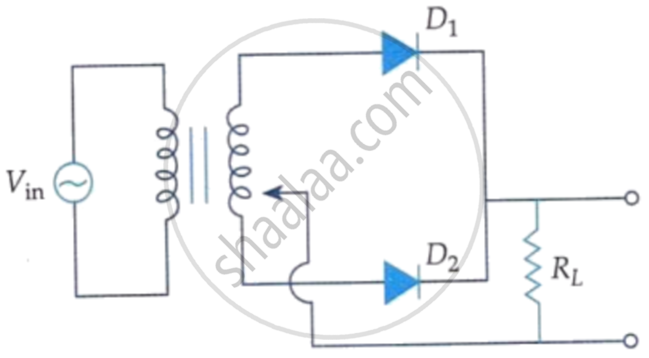
A full wave rectifier circuit diodes (D1) and (D2) is shown in the figure. If input supply voltage Vin = 220 sin (100 πt) volt, then at t = 15 ms.
When the p-side and n-side are joined, in which direction do electrons diffuse?
When the p-side and n-side are joined, in which direction do holes diffuse?
Which practical effect is associated with forward bias?
Which formula gives the forward dynamic (AC) resistance?
