Advertisements
Advertisements
प्रश्न
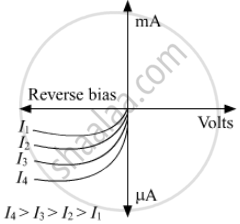
Draw its I – V characteristics of photodiode
Advertisements
उत्तर
I – V characteristics of photodiode:
APPEARS IN
संबंधित प्रश्न
In a photo diode, the conductive increases when the material is exposed to light. It is found that the conductivity changes only if the wavelength is less than 620 nm. What is the band gap?
(Use Planck constant h = 4.14 × 10⁻¹⁵ eV-s, Boltzmann constant k = 8·62 × 10-5 eV/K.)
The power delivered in the plate circular of a diode is 1.0 W when the plate voltage is 36 V. Find the power delivered if the plate voltage is increased to 49 V. Assume Langmuir-Child equation to hold.
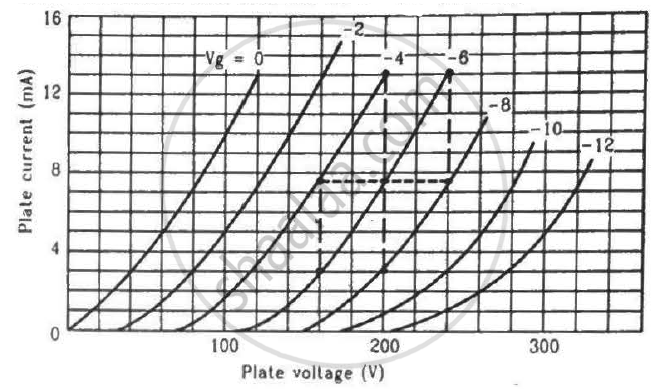
Find the values of rp, µ and gm of a triode operating at plate voltage 200 V and grid voltage −6. The plate characteristics are shown in the figure.
On increasing the reverse biases voltage to a large value in a P – N junction diode-current
In a semiconductor diode, the barrier potential offers opposition to only
Differentiate between the threshold voltage and the breakdown voltage for a diode.
Write the property of a junction diode which makes it suitable for rectification of ac voltages.
What opposes further diffusion in the depletion layer?
What is the V-I characteristic curve of a diode?
What does the comparison of \[10\,\Omega\] in forward bias and \[1.0\times10^{7}\,\Omega\] in reverse bias show?
