Advertisements
Advertisements
प्रश्न
If each diode in figure has a forward bias resistance of 25 Ω and infinite resistance in reverse bias, what will be the values of the current I1, I2, I3 and I4?

Advertisements
उत्तर
According to the problem, forward biased resistance = 25 Ω and reverse biased resistance = ∞
As shown in the figure, the diode in branch CD is in reverse biased which has infinite resistance.
So, the current in that branch is zero, i.e. I3, = 0
Resistance in branch AB = 25 + 125 = 150 Ω say R1
Resistance in branch EF = 25 + 125 = 150 Ω, say R2
AB is parallel to EF
So, effective resistance
`1/R^' = 1/R_1 + 1/R_2 = 1/150 + 1/150 = 2/150`
⇒ R' 75 Ω
Total resistance R of the circuit = R' + 25 = 75 + 25 = 100 Ω
Current `I_1 = V/R = 5/100` = 0.05 A
According to Kirchhoff's, current law (KCL),
I1 = I4 + I2 + I3 .....(Here I3 = 0)
So I1 = I4 + I2
Here, the resistance R1 and R2 are same.
i.e., I4 = I2
∴ I1 = 2I2
⇒ `I_2 = I_1/2 = 0.05/2` = 0.025 A
And I4 = 0.025 A
Therefore, we get, I1 = 0.05 A, I2 = 0.025 A, I3 = 0 and I4 = 0.025 A.
APPEARS IN
संबंधित प्रश्न
(i) Explain with the help of a diagram the formation of depletion region and barrier potential in a pn junction.
What causes the setting up of high electric field even for small reverse bias voltage across the diode?
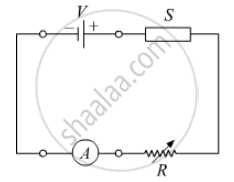
In the following diagram 'S' is a semiconductor. Would you increase or decrease the value of R to keep the reading of the ammeter A constant when S is heated? Give reason for your answer.
What is the use of Zener diode?
Plot a graph showing variation of current versus voltage for the material GaAs ?
The graph shown in the figure represents a plot of current versus voltage for a given semiconductor. Identify the region, if any, over which the semiconductor has a negative resistance.

Show on a graph, the variation of resistivity with temperature for a typical semiconductor.
With reference to Semiconductor Physics,
Name the diode that emits spontaneous radiation when forward biased.
In forward bias width of potential barrier in a p + n junction diode
Use a transistor as an amplition
In a semiconductor diode, the barrier potential offers opposition to only
 (a) |
 (b) |
- Name the type of a diode whose characteristics are shown in figure (A) and figure (B).
- What does the point P in figure (A) represent?
- What does the points P and Q in figure (B) represent?
A Zener of power rating 1 W is to be used as a voltage regulator. If zener has a breakdown of 5 V and it has to regulate voltage which fluctuated between 3 V and 7 V, what should be the value of Rs for safe operation (Figure)?

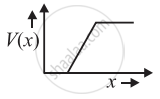
The graph of potential barrier versus width of depletion region for an unbiased diode is shown in graph A. In comparison to A, graphs B and C are obtained after biasing the diode in different ways. Identify the type of biasing in B and C and justify your answer
| ‘A’ | ‘B’ | ‘C’ |
 |
 |
 |
Write the property of a junction diode which makes it suitable for rectification of ac voltages.
Explain the formation of the barrier potential in a p-n junction.
What is meant by forward biasing of a semiconductor diode?
Which practical effect is associated with forward bias?
What happens to reverse current at the breakdown voltage?
