Advertisements
Advertisements
प्रश्न
If each diode in figure has a forward bias resistance of 25 Ω and infinite resistance in reverse bias, what will be the values of the current I1, I2, I3 and I4?

Advertisements
उत्तर
According to the problem, forward biased resistance = 25 Ω and reverse biased resistance = ∞
As shown in the figure, the diode in branch CD is in reverse biased which has infinite resistance.
So, the current in that branch is zero, i.e. I3, = 0
Resistance in branch AB = 25 + 125 = 150 Ω say R1
Resistance in branch EF = 25 + 125 = 150 Ω, say R2
AB is parallel to EF
So, effective resistance
`1/R^' = 1/R_1 + 1/R_2 = 1/150 + 1/150 = 2/150`
⇒ R' 75 Ω
Total resistance R of the circuit = R' + 25 = 75 + 25 = 100 Ω
Current `I_1 = V/R = 5/100` = 0.05 A
According to Kirchhoff's, current law (KCL),
I1 = I4 + I2 + I3 .....(Here I3 = 0)
So I1 = I4 + I2
Here, the resistance R1 and R2 are same.
i.e., I4 = I2
∴ I1 = 2I2
⇒ `I_2 = I_1/2 = 0.05/2` = 0.025 A
And I4 = 0.025 A
Therefore, we get, I1 = 0.05 A, I2 = 0.025 A, I3 = 0 and I4 = 0.025 A.
APPEARS IN
संबंधित प्रश्न
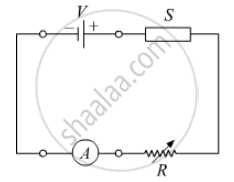
In the following diagram 'S' is a semiconductor. Would you increase or decrease the value of R to keep the reading of the ammeter A constant when S is heated? Give reason for your answer.
In the following diagram, is the junction diode forward biased or reverse biased ?
Show on a graph, the variation of resistivity with temperature for a typical semiconductor.
In a photo diode, the conductive increases when the material is exposed to light. It is found that the conductivity changes only if the wavelength is less than 620 nm. What is the band gap?
(Use Planck constant h = 4.14 × 10⁻¹⁵ eV-s, Boltzmann constant k = 8·62 × 10-5 eV/K.)
The power delivered in the plate circular of a diode is 1.0 W when the plate voltage is 36 V. Find the power delivered if the plate voltage is increased to 49 V. Assume Langmuir-Child equation to hold.
The dynamic plate resistance of a triode value is 10 kΩ. Find the change in the plate current if the plate voltage is changed from 200 V to 220 V.
The gain factor of an amplifier in increased from 10 to 12 as the load resistance is changed from 4 kΩ to 8 kΩ. Calculate (a) the amplification factor and (b) the plate resistance.
In semiconductor physics, what is meant by:
(i) rectifier
(ii) an amplifier
(iii) an oscillator
Basic materials used in the present solid state electronic devices like diode, transistor, ICs, etc are ______.
The drift current in a p-n junction is from the ______.
In forward bias width of potential barrier in a p + n junction diode
When an electric field is applied across a semiconductor ______.
- electrons move from lower energy level to higher energy level in the conduction band.
- electrons move from higher energy level to lower energy level in the conduction band.
- holes in the valence band move from higher energy level to lower energy level.
- holes in the valence band move from lower energy level to higher energy level.
Draw the circuit arrangement for studying V-I characteristics of a p-n junction diode in (i) forward biasing and (ii) reverse biasing. Draw the typical V-I characteristics of a silicon diode.
Choose the correct circuit which can achieve the bridge balance.
What is left behind near the junction, creating a depletion layer?
What is the V-I characteristic curve of a diode?
How does effective resistance compare between forward bias after the cut-in voltage and reverse bias before breakdown?
Which voltage corresponds to a forward current of \[10\,\mathrm{mA}\]?
Which formula gives the forward dynamic (AC) resistance?
