Advertisements
Advertisements
प्रश्न
A Zener of power rating 1 W is to be used as a voltage regulator. If zener has a breakdown of 5 V and it has to regulate voltage which fluctuated between 3 V and 7 V, what should be the value of Rs for safe operation (Figure)?

Advertisements
उत्तर
According to the problem, power = 1 W
Zener breakdown voltage, Vz = 5 V
Minimum voltage, Vmin = 3 V
Maximum voltage, Vmax = 7 V
We know, P = VI
So, current `I_(Z_("max")) = P/V_Z = 1/5` = 0.2 A
For safe operation Rs will be equal to `R_S = (V_("max") - V_Z)/I_(Z_("max"))`
= `(7 - 5)/0.2`
= `2/0.2`
= 10 Ω
APPEARS IN
संबंधित प्रश्न
With reference to semiconductor devices, define a p-type semiconductor and a Zener diode.
The plate current in a diode is 20 mA when the plate voltage is 50 V or 60 V. What will be the current if the plate voltage is 70 V?
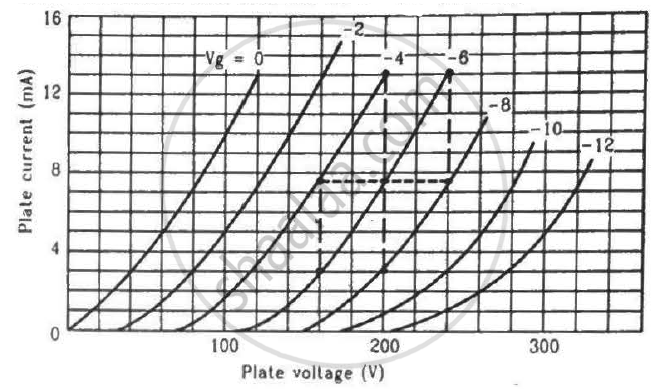
Find the values of rp, µ and gm of a triode operating at plate voltage 200 V and grid voltage −6. The plate characteristics are shown in the figure.
Answer the following question.
Why photodiodes are required to operate in reverse bias? Explain.
With reference to Semiconductor Physics,
Name the diode that emits spontaneous radiation when forward biased.
Of the diodes shown in the following diagrams, which one is reverse biased?
Use a transistor as an amplition
In the depletion region of a diode ______.
- there are no mobile charges.
- equal number of holes and electrons exist, making the region neutral.
- recombination of holes and electrons has taken place.
- immobile charged ions exist.
 (a) |
 (b) |
- Name the type of a diode whose characteristics are shown in figure (A) and figure (B).
- What does the point P in figure (A) represent?
- What does the points P and Q in figure (B) represent?
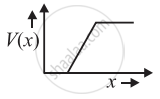
The graph of potential barrier versus width of depletion region for an unbiased diode is shown in graph A. In comparison to A, graphs B and C are obtained after biasing the diode in different ways. Identify the type of biasing in B and C and justify your answer
| ‘A’ | ‘B’ | ‘C’ |
 |
 |
 |
With reference to a semiconductor diode, define the potential barrier.
What is meant by forward biasing of a semiconductor diode?
An ideal PN junction diode offers ______.
What is left behind near the junction, creating a depletion layer?
What is the approximate cut-in voltage of a germanium diode?
What is the V-I characteristic curve of a diode?
What current flows in the reverse-bias V-I characteristic before breakdown?
Which expression applies Ohm's law to reverse-biased resistance?
What does the comparison of \[10\,\Omega\] in forward bias and \[1.0\times10^{7}\,\Omega\] in reverse bias show?
