Advertisements
Advertisements
Question
A Zener of power rating 1 W is to be used as a voltage regulator. If zener has a breakdown of 5 V and it has to regulate voltage which fluctuated between 3 V and 7 V, what should be the value of Rs for safe operation (Figure)?

Advertisements
Solution
According to the problem, power = 1 W
Zener breakdown voltage, Vz = 5 V
Minimum voltage, Vmin = 3 V
Maximum voltage, Vmax = 7 V
We know, P = VI
So, current `I_(Z_("max")) = P/V_Z = 1/5` = 0.2 A
For safe operation Rs will be equal to `R_S = (V_("max") - V_Z)/I_(Z_("max"))`
= `(7 - 5)/0.2`
= `2/0.2`
= 10 Ω
APPEARS IN
RELATED QUESTIONS
Draw its I – V characteristics of photodiode
A plate current of 10 mA is obtained when 60 volts are applied across a diode tube. Assuming the Langmuir-Child relation \[i_p \infty V_p^{3/2}\] to hold, find the dynamic resistance rp in this operating condition.
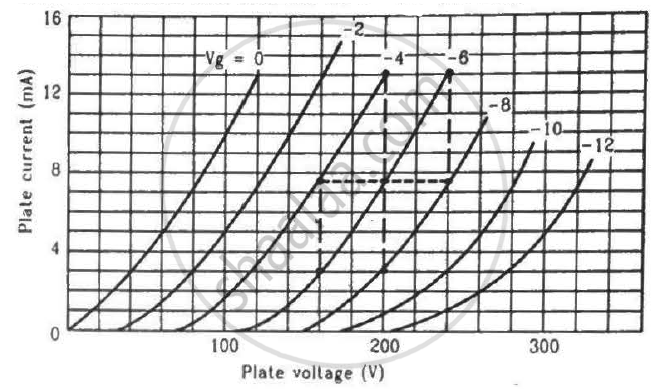
Find the values of rp, µ and gm of a triode operating at plate voltage 200 V and grid voltage −6. The plate characteristics are shown in the figure.
The gain factor of an amplifier in increased from 10 to 12 as the load resistance is changed from 4 kΩ to 8 kΩ. Calculate (a) the amplification factor and (b) the plate resistance.
Answer the following question.
Why photodiodes are required to operate in reverse bias? Explain.
Avalanche breakdown is due to ______.
When an electric field is applied across a semiconductor ______.
- electrons move from lower energy level to higher energy level in the conduction band.
- electrons move from higher energy level to lower energy level in the conduction band.
- holes in the valence band move from higher energy level to lower energy level.
- holes in the valence band move from lower energy level to higher energy level.
Consider an npn transistor with its base-emitter junction forward biased and collector base junction reverse biased. Which of the following statements are true?
- Electrons crossover from emitter to collector.
- Holes move from base to collector.
- Electrons move from emitter to base.
- Electrons from emitter move out of base without going to the collector.
Consider an npn transistor with its base-emitter junction forward biased and collector base junction reverse biased. Which of the following statements are true?
- Electrons crossover from emitter to collector.
- Holes move from base to collector.
- Electrons move from emitter to base.
- Electrons from emitter move out of base without going to the collector.
The breakdown in a reverse biased p–n junction diode is more likely to occur due to ______.
- large velocity of the minority charge carriers if the doping concentration is small.
- large velocity of the minority charge carriers if the doping concentration is large.
- strong electric field in a depletion region if the doping concentration is small.
- strong electric field in the depletion region if the doping concentration is large.
Can the potential barrier across a p-n junction be measured by simply connecting a voltmeter across the junction?
 (a) |
 (b) |
- Name the type of a diode whose characteristics are shown in figure (A) and figure (B).
- What does the point P in figure (A) represent?
- What does the points P and Q in figure (B) represent?
Differentiate between the threshold voltage and the breakdown voltage for a diode.
Explain the formation of the barrier potential in a p-n junction.
Describe the following term briefly:
Minority carrier injection in forward biasing.
An ideal PN junction diode offers ______.
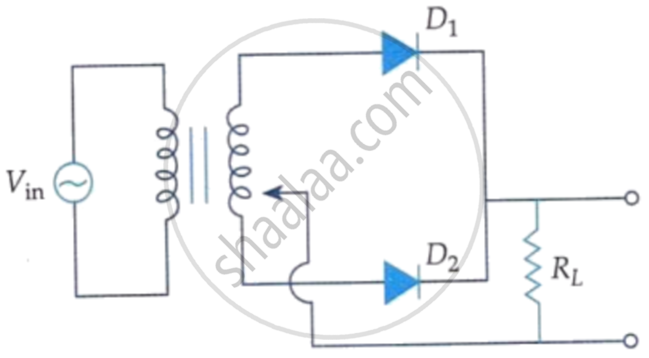
A full wave rectifier circuit diodes (D1) and (D2) is shown in the figure. If input supply voltage Vin = 220 sin (100 πt) volt, then at t = 15 ms.
What is the approximate cut-in voltage of a silicon diode?
Which formula gives the forward dynamic (AC) resistance?
