Advertisements
Advertisements
Question
In Figure, Vo is the potential barrier across a p-n junction, when no battery is connected across the junction ______.

Options
1 and 3 both correspond to forward bias of junction.
3 corresponds to forward bias of junction and 1 corresponds to reverse bias of junction.
1 corresponds to forward bias and 3 corresponds to reverse bias of junction.
3 and 1 both correspond to reverse bias of junction.
Advertisements
Solution
In Figure, Vo is the potential barrier across a p-n junction, when no battery is connected across the junction 3 corresponds to forward bias of junction and 1 corresponds to reverse bias of junction.
Explanation:
P-N Junction Diode: When a P-type semiconductor is suitably joined to an N-type semiconductor, then the resulting arrangement is called a P-N junction or P-N junction diode.

(1) Depletion region: On account of the difference in concentration of charge carrier in the two sections of the P-N junction, the electrons from N-region diffuse through the junction into P-region and the hole from the P region diffuses into N-region.
Due to diffusion, the neutrality of both N and P-type semiconductor is disturbed and a layer of negatively charged ions appear near the junction in the P-crystal and a layer of positive ions appears near the junction in N-crystal. This layer is called the depletion layer.

- The thickness of the depletion layer is 1 micron = 10–6 m.
- Width of the depletion layer ∝ `1/"Dopping"`
- Depletion is directly proportional to temperature.
- The P-N junction diode is equivalent to the capacitor in which the depletion layer acts as a dielectric.
(2) Potential barrier: The potential difference created across the P-N junction due to the diffusion of electrons and holes is called the potential barrier.
For Ge, VB = 0.3 V and for silicon VB = 0. 7 V
On average the potential barrier in a P-N junction is – 0.5 V and the width of the depletion region = 10–6m.
So the barrier electric field `E = V/d = 0.5/10^-6 = 5 xx 10^5` V/m
The height of the potential barrier is decreased when the p-n junction is forward biased, it opposes the potential barrier junction when the p-n junction is reverse biased and it supports the potential barrier junction, resulting increase in the potential barrier across the junction.
APPEARS IN
RELATED QUESTIONS
When a forward bias is applied to a p-n junction, it ______.
With reference to semiconductor devices, define a p-type semiconductor and a Zener diode.
Why is a zener diode considered as a special purpose semiconductor diode?
In a photo diode, the conductive increases when the material is exposed to light. It is found that the conductivity changes only if the wavelength is less than 620 nm. What is the band gap?
(Use Planck constant h = 4.14 × 10⁻¹⁵ eV-s, Boltzmann constant k = 8·62 × 10-5 eV/K.)
A plate current of 10 mA is obtained when 60 volts are applied across a diode tube. Assuming the Langmuir-Child relation \[i_p \infty V_p^{3/2}\] to hold, find the dynamic resistance rp in this operating condition.
The dynamic plate resistance of a triode value is 10 kΩ. Find the change in the plate current if the plate voltage is changed from 200 V to 220 V.
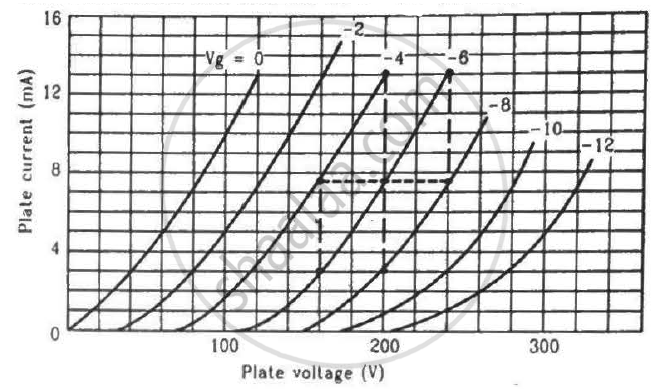
Find the values of rp, µ and gm of a triode operating at plate voltage 200 V and grid voltage −6. The plate characteristics are shown in the figure.
Basic materials used in the present solid state electronic devices like diode, transistor, ICs, etc are ______.
The current through an ideal PN-junction shown in the following circuit diagram will be:

A – pn junction has a depletion layer of thickness .of the order of
If each diode in figure has a forward bias resistance of 25 Ω and infinite resistance in reverse bias, what will be the values of the current I1, I2, I3 and I4?

Draw V-I characteristics of a p-n Junction diode.
Explain the formation of the barrier potential in a p-n junction.
Answer the following giving reasons:
A p-n junction diode is damaged by a strong current.
What occurs near the junction when the p-side and n-side are joined?
What opposes further diffusion in the depletion layer?
What happens to reverse current at the breakdown voltage?
How does effective resistance compare between forward bias after the cut-in voltage and reverse bias before breakdown?
