Advertisements
Advertisements
Question
Differentiate between the threshold voltage and the breakdown voltage for a diode.
Advertisements
Solution
| Threshold voltage | Breakdown voltage | |
| (i) | The forward voltage at which the current through the p-n junction starts increasing rapidly is known as the threshold voltage. | Reverse voltage at which the p-n junction breakdown occurs is called the breakdown voltage. |
| (ii) | The magnitude of this voltage is lower than the breakdown voltage. | The magnitude of this voltage is higher than the threshold voltage. |
APPEARS IN
RELATED QUESTIONS
What happens when a forward bias is applied to a p-n junction?
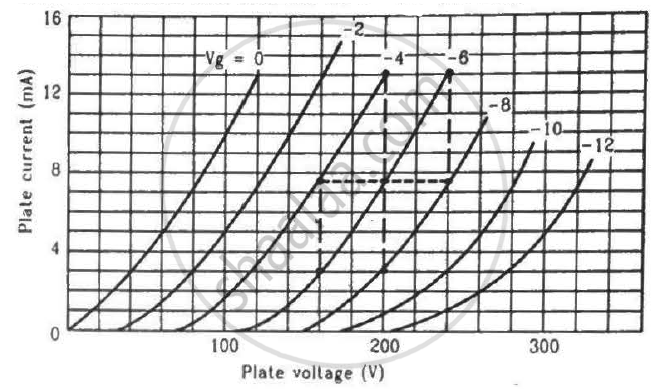
Find the values of rp, µ and gm of a triode operating at plate voltage 200 V and grid voltage −6. The plate characteristics are shown in the figure.
The gain factor of an amplifier in increased from 10 to 12 as the load resistance is changed from 4 kΩ to 8 kΩ. Calculate (a) the amplification factor and (b) the plate resistance.
With reference to a semiconductor diode, what is meant by:
(i) Forward bias
(ii) Reverse bias
(iii) Depletion region
The drift current in a p-n junction is from the ______.
Depletion layer in p - n junction diode consists of
Avalanche breakdown is due to ______.
The breakdown in a reverse biased p–n junction diode is more likely to occur due to ______.
- large velocity of the minority charge carriers if the doping concentration is small.
- large velocity of the minority charge carriers if the doping concentration is large.
- strong electric field in a depletion region if the doping concentration is small.
- strong electric field in the depletion region if the doping concentration is large.
A semiconductor device is connected in series with a battery, an ammeter and a resistor. A current flows in the circuit. If. the polarity of the battery is reversed, the current in the circuit almost becomes zero. The device is a/an ______.
What is meant by forward biasing of a semiconductor diode?
