Advertisements
Advertisements
Question
Draw V-I characteristics of a p-n Junction diode.
Advertisements
Solution

APPEARS IN
RELATED QUESTIONS
With reference to semiconductor devices, define a p-type semiconductor and a Zener diode.
Show on a graph, the variation of resistivity with temperature for a typical semiconductor.
Find the values of rp, µ and gm of a triode operating at plate voltage 200 V and grid voltage −6. The plate characteristics are shown in the figure.
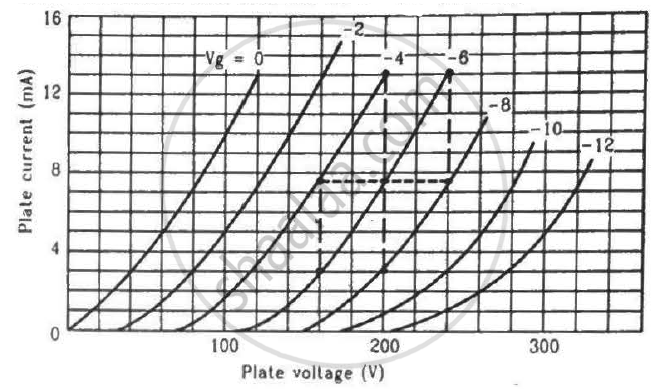
The gain factor of an amplifier in increased from 10 to 12 as the load resistance is changed from 4 kΩ to 8 kΩ. Calculate (a) the amplification factor and (b) the plate resistance.
With reference to a semiconductor diode, what is meant by:
(i) Forward bias
(ii) Reverse bias
(iii) Depletion region
The drift current in a p-n junction is from the ______.
An ideal PN junction diode offers ______.
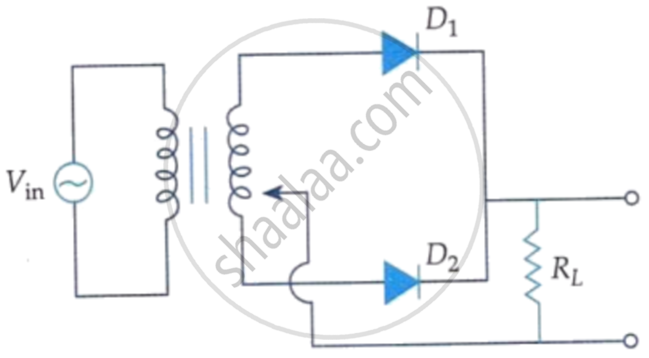
A full wave rectifier circuit diodes (D1) and (D2) is shown in the figure. If input supply voltage Vin = 220 sin (100 πt) volt, then at t = 15 ms.
What is left behind near the junction, creating a depletion layer?
What is the approximate cut-in voltage of a germanium diode?
