Advertisements
Advertisements
प्रश्न
In Figure, Vo is the potential barrier across a p-n junction, when no battery is connected across the junction ______.

विकल्प
1 and 3 both correspond to forward bias of junction.
3 corresponds to forward bias of junction and 1 corresponds to reverse bias of junction.
1 corresponds to forward bias and 3 corresponds to reverse bias of junction.
3 and 1 both correspond to reverse bias of junction.
Advertisements
उत्तर
In Figure, Vo is the potential barrier across a p-n junction, when no battery is connected across the junction 3 corresponds to forward bias of junction and 1 corresponds to reverse bias of junction.
Explanation:
P-N Junction Diode: When a P-type semiconductor is suitably joined to an N-type semiconductor, then the resulting arrangement is called a P-N junction or P-N junction diode.

(1) Depletion region: On account of the difference in concentration of charge carrier in the two sections of the P-N junction, the electrons from N-region diffuse through the junction into P-region and the hole from the P region diffuses into N-region.
Due to diffusion, the neutrality of both N and P-type semiconductor is disturbed and a layer of negatively charged ions appear near the junction in the P-crystal and a layer of positive ions appears near the junction in N-crystal. This layer is called the depletion layer.

- The thickness of the depletion layer is 1 micron = 10–6 m.
- Width of the depletion layer ∝ `1/"Dopping"`
- Depletion is directly proportional to temperature.
- The P-N junction diode is equivalent to the capacitor in which the depletion layer acts as a dielectric.
(2) Potential barrier: The potential difference created across the P-N junction due to the diffusion of electrons and holes is called the potential barrier.
For Ge, VB = 0.3 V and for silicon VB = 0. 7 V
On average the potential barrier in a P-N junction is – 0.5 V and the width of the depletion region = 10–6m.
So the barrier electric field `E = V/d = 0.5/10^-6 = 5 xx 10^5` V/m
The height of the potential barrier is decreased when the p-n junction is forward biased, it opposes the potential barrier junction when the p-n junction is reverse biased and it supports the potential barrier junction, resulting increase in the potential barrier across the junction.
APPEARS IN
संबंधित प्रश्न
What happens when a forward bias is applied to a p-n junction?
When a forward bias is applied to a p-n junction, it ______.
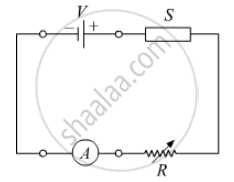
In the following diagram 'S' is a semiconductor. Would you increase or decrease the value of R to keep the reading of the ammeter A constant when S is heated? Give reason for your answer.
Draw its I – V characteristics of photodiode
Show on a graph, the variation of resistivity with temperature for a typical semiconductor.
Why is a zener diode considered as a special purpose semiconductor diode?
With reference to semi-conductors answer the following :
(i) What is the change in the resistance of the semi-conductor with increase in temperature ?
(ii) Name the majority charge carriers in n-type semi-conductor.
(iii) What is meant by doping ?
A plate current of 10 mA is obtained when 60 volts are applied across a diode tube. Assuming the Langmuir-Child relation \[i_p \infty V_p^{3/2}\] to hold, find the dynamic resistance rp in this operating condition.
The plate current in a diode is 20 mA when the plate voltage is 50 V or 60 V. What will be the current if the plate voltage is 70 V?
Diffusion in a p-n junction is due to ______.
We use alloys for making standard resistors because they have ____________.
With reference to Semiconductor Physics,
Name the diode that emits spontaneous radiation when forward biased.
A – pn junction has a depletion layer of thickness .of the order of
In a semiconductor diode, the barrier potential offers opposition to only
Consider an npn transistor with its base-emitter junction forward biased and collector base junction reverse biased. Which of the following statements are true?
- Electrons crossover from emitter to collector.
- Holes move from base to collector.
- Electrons move from emitter to base.
- Electrons from emitter move out of base without going to the collector.
Figure shows the transfer characteristics of a base biased CE transistor. Which of the following statements are true?

At Vi = 0.4 V, transistor is in active state.
At Vi = 1 V, it can be used as an amplifier.
At Vi = 0.5 V, it can be used as a switch turned off.
At Vi = 2.5 V, it can be used as a switch turned on.
If each diode in figure has a forward bias resistance of 25 Ω and infinite resistance in reverse bias, what will be the values of the current I1, I2, I3 and I4?

Answer the following giving reasons:
A p-n junction diode is damaged by a strong current.
Draw the circuit arrangement for studying V-I characteristics of a p-n junction diode in (i) forward biasing and (ii) reverse biasing. Draw the typical V-I characteristics of a silicon diode.
Describe the following term briefly:
Minority carrier injection in forward biasing.
