Advertisements
Advertisements
प्रश्न
In the depletion region of a diode ______.
- there are no mobile charges.
- equal number of holes and electrons exist, making the region neutral.
- recombination of holes and electrons has taken place.
- immobile charged ions exist.
पर्याय
a and b
a, b and d
c and d
a, b, c and d
Advertisements
उत्तर
a, b, c and d
Explanation:
On account of the difference in concentration of charge carrier in the two sections of the P-N junction, the electrons from N-region diffuse through the junction into P-region and the hole from P-region diffuse into N-region.

Due to diffusion, the neutrality of both N and P-type semiconductor is disturbed, a layer of negatively charged ions appear near the junction in the P-crystal and a layer of positive ions appears near the junction in N-crystal. This layer is called the depletion layer.
The thickness of the depletion layer is 1 micron = 10-6 m.
Width of depletion layer ∞ 1/Dopping
Depletion is directly proportional to temperature.
Important point: The P-N junction diode is equivalent to the capacitor in which the depletion layer acts as a dielectric.
APPEARS IN
संबंधित प्रश्न
(i) Explain with the help of a diagram the formation of depletion region and barrier potential in a pn junction.
With reference to semiconductor devices, define a p-type semiconductor and a Zener diode.
Draw a labelled diagram of a full wave rectifier. Show how output voltage varies with time if the input voltage is a sinusoidal voltage.
Why is a zener diode considered as a special purpose semiconductor diode?
A plate current of 10 mA is obtained when 60 volts are applied across a diode tube. Assuming the Langmuir-Child relation \[i_p \infty V_p^{3/2}\] to hold, find the dynamic resistance rp in this operating condition.
The dynamic plate resistance of a triode value is 10 kΩ. Find the change in the plate current if the plate voltage is changed from 200 V to 220 V.
The gain factor of an amplifier in increased from 10 to 12 as the load resistance is changed from 4 kΩ to 8 kΩ. Calculate (a) the amplification factor and (b) the plate resistance.
With reference to a semiconductor diode, what is meant by:
(i) Forward bias
(ii) Reverse bias
(iii) Depletion region
Diffusion in a p-n junction is due to ______.
The expected energy of the electron at absolute zero is called:-
When an electric field is applied across a semiconductor ______.
- electrons move from lower energy level to higher energy level in the conduction band.
- electrons move from higher energy level to lower energy level in the conduction band.
- holes in the valence band move from higher energy level to lower energy level.
- holes in the valence band move from lower energy level to higher energy level.
Consider an npn transistor with its base-emitter junction forward biased and collector base junction reverse biased. Which of the following statements are true?
- Electrons crossover from emitter to collector.
- Holes move from base to collector.
- Electrons move from emitter to base.
- Electrons from emitter move out of base without going to the collector.
Draw V-I characteristics of a p-n Junction diode.
Describe the following term briefly:
Minority carrier injection in forward biasing.
Describe the following term briefly:
Breakdown voltage in reverse biasing
Draw a labelled characteristic curve (l-V graph) for a semiconductor diode during forward bias.
An ideal PN junction diode offers ______.
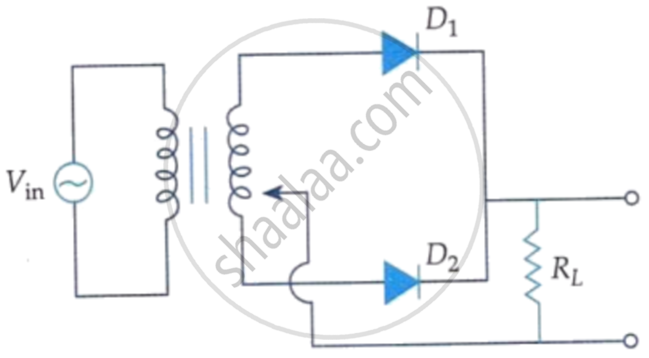
A full wave rectifier circuit diodes (D1) and (D2) is shown in the figure. If input supply voltage Vin = 220 sin (100 πt) volt, then at t = 15 ms.