Advertisements
Advertisements
प्रश्न
A triode value operates at Vp = 225 V and Vg = −0.5 V.
The plate current remains unchanged if the plate voltage is increased to 250 V and the grid voltage is decreased to −2.5 V. Calculate the amplification factor.
Advertisements
उत्तर
Amplification factor for a triode valve,
\[\mu = \frac{\text{Change in Plate Voltage}}{\text{Change in Grid Voltage}}\]
At constant plate current,
\[\mu = \left(\frac{\delta V_P}{\delta V_G}\right)_{i_P = constant} \]
\[\mu = \frac{250 - 225}{2 . 5 - 0 . 5}\]
\[\mu = \frac{25}{2} = 12 . 5\]
This implies that the amplification factor of the triode is 12.5
APPEARS IN
संबंधित प्रश्न
What causes the setting up of high electric field even for small reverse bias voltage across the diode?
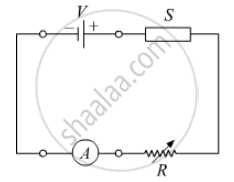
In the following diagram 'S' is a semiconductor. Would you increase or decrease the value of R to keep the reading of the ammeter A constant when S is heated? Give reason for your answer.
The plate current in a diode is 20 mA when the plate voltage is 50 V or 60 V. What will be the current if the plate voltage is 70 V?
Basic materials used in the present solid state electronic devices like diode, transistor, ICs, etc are ______.
We use alloys for making standard resistors because they have ____________.
With reference to Semiconductor Physics,
Name the diode that emits spontaneous radiation when forward biased.
What are the applications of p - n Junction diode?
Avalanche breakdown is due to ______.
Consider an npn transistor with its base-emitter junction forward biased and collector base junction reverse biased. Which of the following statements are true?
- Electrons crossover from emitter to collector.
- Holes move from base to collector.
- Electrons move from emitter to base.
- Electrons from emitter move out of base without going to the collector.
Can the potential barrier across a p-n junction be measured by simply connecting a voltmeter across the junction?
 (a) |
 (b) |
- Name the type of a diode whose characteristics are shown in figure (A) and figure (B).
- What does the point P in figure (A) represent?
- What does the points P and Q in figure (B) represent?
If each diode in figure has a forward bias resistance of 25 Ω and infinite resistance in reverse bias, what will be the values of the current I1, I2, I3 and I4?

Draw V-I characteristics of a p-n Junction diode.
Answer the following giving reasons:
A p-n junction diode is damaged by a strong current.
A semiconductor device is connected in series with a battery, an ammeter and a resistor. A current flows in the circuit. If. the polarity of the battery is reversed, the current in the circuit almost becomes zero. The device is a/an ______.
With reference to a semiconductor diode, define the potential barrier.
What occurs near the junction when the p-side and n-side are joined?
Which practical effect is associated with forward bias?
Which expression applies Ohm's law to reverse-biased resistance?
What does the comparison of \[10\,\Omega\] in forward bias and \[1.0\times10^{7}\,\Omega\] in reverse bias show?
