Advertisements
Advertisements
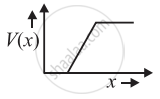
प्रश्न
 (a) |
 (b) |
- Name the type of a diode whose characteristics are shown in figure (A) and figure (B).
- What does the point P in figure (A) represent?
- What does the points P and Q in figure (B) represent?
Advertisements
उत्तर
- Figure (a) represents the characteristics of the Zener diode and curve (b) is of the solar cell.
- In figure (a), point P represents Zener breakdown voltage.
- In figure (b), point Q represents zero voltage and negative current. This means the light falling on the solar cell with at least a minimum threshold frequency gives the current in opposite direction to that due to a battery connected to solar cell. But for point Q the battery is short-circuited. Hence it represents the short circuit current. And the point Pin fig. (b) represents some open circuit, the voltage on solar cell with zero current through solar cell.
It means, there is a battery connected to a solar cell which gives rise to the equal and opposite current to that in a solar cell by virtue of light falling on it.
APPEARS IN
संबंधित प्रश्न
When a forward bias is applied to a p-n junction, it ______.
Plot a graph showing variation of current versus voltage for the material GaAs ?
The graph shown in the figure represents a plot of current versus voltage for a given semiconductor. Identify the region, if any, over which the semiconductor has a negative resistance.

In a photo diode, the conductive increases when the material is exposed to light. It is found that the conductivity changes only if the wavelength is less than 620 nm. What is the band gap?
(Use Planck constant h = 4.14 × 10⁻¹⁵ eV-s, Boltzmann constant k = 8·62 × 10-5 eV/K.)
A plate current of 10 mA is obtained when 60 volts are applied across a diode tube. Assuming the Langmuir-Child relation \[i_p \infty V_p^{3/2}\] to hold, find the dynamic resistance rp in this operating condition.
The dynamic plate resistance of a triode value is 10 kΩ. Find the change in the plate current if the plate voltage is changed from 200 V to 220 V.
The current through an ideal PN-junction shown in the following circuit diagram will be:

The drift current in a p-n junction is from the ______.
In forward bias width of potential barrier in a p + n junction diode
Consider an npn transistor with its base-emitter junction forward biased and collector base junction reverse biased. Which of the following statements are true?
- Electrons crossover from emitter to collector.
- Holes move from base to collector.
- Electrons move from emitter to base.
- Electrons from emitter move out of base without going to the collector.
A Zener of power rating 1 W is to be used as a voltage regulator. If zener has a breakdown of 5 V and it has to regulate voltage which fluctuated between 3 V and 7 V, what should be the value of Rs for safe operation (Figure)?

The graph of potential barrier versus width of depletion region for an unbiased diode is shown in graph A. In comparison to A, graphs B and C are obtained after biasing the diode in different ways. Identify the type of biasing in B and C and justify your answer
| ‘A’ | ‘B’ | ‘C’ |
 |
 |
 |
A semiconductor device is connected in series with a battery, an ammeter and a resistor. A current flows in the circuit. If. the polarity of the battery is reversed, the current in the circuit almost becomes zero. The device is a/an ______.
What is meant by forward biasing of a semiconductor diode?
When the p-side and n-side are joined, in which direction do electrons diffuse?
What happens to reverse current at the breakdown voltage?
How does effective resistance compare between forward bias after the cut-in voltage and reverse bias before breakdown?
Which formula gives the forward dynamic (AC) resistance?
