मराठी
कर्नाटक बोर्ड पी.यू.सी.पीयूसी विज्ञान 2nd PUC Class 12

Three photo diodes D1, D2 and D3 are made of semiconductors having band gaps of 2.5 eV, 2 eV and 3 eV, respectively. Which 0 ones will be able to detect light of wavelength 6000 Å? - Physics

Advertisements
Advertisements

प्रश्न

Three photo diodes D1, D2 and D3 are made of semiconductors having band gaps of 2.5 eV, 2 eV and 3 eV, respectively. Which 0 ones will be able to detect light of wavelength 6000 Å?

टीपा लिहा
Advertisements

उत्तर

In Photodiodes, electron and hole pairs are created by the junction photoelectric effect. That is the covalent bonds are broken by the EM radiations absorbed by the electron in the V.B. These are used for detecting light signals.
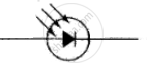

According to the problem,

The wavelength of light λ = 6000 Å = 6000 × 10-10 m

The energy of the light photon `E = (hc)/λ = (6.6 xx 10^-34 xx 3 xx 10^8)/(6000 xx 10^-10 xx 1.6 xx 10^-19)` eV = 2.06 eV

The incident radiation is detected by the photodiode D2 because the energy of incident radiation is greater than the band gap.

shaalaa.com
  या प्रश्नात किंवा उत्तरात काही त्रुटी आहे का?
पाठ 14: Semiconductor Electronics - Exercises [पृष्ठ ९२]

APPEARS IN

एनसीईआरटी एक्झांप्लर Physics [English] Class 12
पाठ 14 Semiconductor Electronics
Exercises | Q 14.24 | पृष्ठ ९२

व्हिडिओ ट्यूटोरियलVIEW ALL [2]

संबंधित प्रश्‍न

Draw energy band diagrams of an n-type and p-type semiconductor at temperature T > 0 K. Mark the donor and acceptor energy levels with their energies.


How many 1s energy states are present in one mole of sodium vapour? Are they all filled in normal conditions? How many 3s energy states are present in one mole of sodium vapour? Are they all filled in normal conditions?


In semiconductors, thermal collisions are responsible for taking a valence electron to the conduction band. Why does the number of conduction electrons not go on increasing with time as thermal collisions continuously take place?


What is the resistance of an intrinsic semiconductor at 0 K?


Electric conduction in a semiconductor takes place due to


Calculate the number of states per cubic metre of sodium in 3s band. The density of sodium is 1013 kgm−3. How many of them are empty?


Indium antimonide has a band gap of 0.23 eV between the valence and the conduction band. Find the temperature at which kT equals the band gap.


The band gap for silicon is 1.1 eV. (a) Find the ratio of the band gap to kT for silicon at room temperature 300 K. (b) At what temperature does this ratio become one tents of the value at 300 K? (Silicon will not retain its structure at these high temperatures.)

(Use Planck constant h = 4.14 × 10⁻¹⁵ eV-s, Boltzmann constant k = 8·62 × 10-5 eV/K.)


When a semiconducting material is doped with an impurity, new acceptor levels are created. In a particular thermal collision, a valence electron receives an energy equal to 2kT and just reaches one of the acceptor levels. Assuming that the energy of the electron was at the top edge of the valence band and that the temperature T is equal to 300 K, find the energy of the acceptor levels above the valence band.


Suppose the energy liberated in the recombination of a hole-electron pair is converted into electromagnetic radiation. If the maximum wavelength emitted is 820 nm, what is the band gap?

(Use Planck constant h = 4.14 × 10⁻¹⁵ eV-s, Boltzmann constant k = 8·62 × 10-5 eV/K.)


Find the maximum wavelength of electromagnetic radiation which can create a hole-electron pair in germanium. The band gap in germanium is 0.65 eV.

(Use Planck constant h = 4.14 × 10⁻¹⁵ eV-s, Boltzmann constant k = 8·62 × 10-5 eV/K.)


The product of the hole concentration and the conduction electron concentration turns out to be independent of the amount of any impurity doped. The concentration of conduction electrons in germanium is 6 × 10¹⁹ per cubic metref conduction electrons increases to 2 × 10²³ per cubic metre. Find the concentration of the holes in the doped germanium.. When some phosphorus impurity is doped into a germanium sample, the concentration o


A semiconducting material has a band gap of 1 eV. Acceptor impurities are doped into it which create acceptor levels 1 meV above the valence band. Assume that the transition from one energy level to the other is almost forbidden if kT is less than 1/50 of the energy gap. Also if kT is more than twice the gap, the upper levels have maximum population. The temperature of the semiconductor is increased from 0 K. The concentration of the holes increases with temperature and after a certain temperature it becomes approximately constant. As the temperature is further increased, the hole concentration again starts increasing at a certain temperature. Find the order of the temperature range in which the hole concentration remains approximately constant.

(Use Planck constant h = 4.14 × 10⁻¹⁵ eV-s, Boltzmann constant k = 8·62 × 10-5 eV/K.)


With reference to Semiconductor Physics,

Draw a labelled energy band diagram for a semiconductor.


Hydrogen atom in n = 3 state has a lifetime of 10-10 sec. The number of revolutions an electron makes in the n = 3 state before returning to the ground state is ______.

Useful data

`1/(4pi∈_0) = 8.99 xx 10^-34`N m2 C-2; e = 1.60 10-19 C; h = 6.63  10-34 Js; me = 9 × 10⁻³ kg


An n-type semiconductor is


In a common base configuration Ie = 1 mA α = 0.95 the value of base current is


The reaction between α and β parameter of a transistor is given by


The energy required by an electron to jump the forbidden band in silicon at room temperature is about ______.


Share
Notifications

Englishहिंदीमराठी


      Forgot password?
Use app×