मराठी
कर्नाटक बोर्ड पी.यू.सी.पीयूसी विज्ञान 2nd PUC Class 12

If the resistance R1 is increased (Figure), how will the readings of the ammeter and voltmeter change? - Physics

Advertisements
Advertisements

प्रश्न

If the resistance R1 is increased (Figure), how will the readings of the ammeter and voltmeter change?

टीपा लिहा
Advertisements

उत्तर

Let us redraw the circuit diagram to find the change in reading of the ammeter and voltmeter.
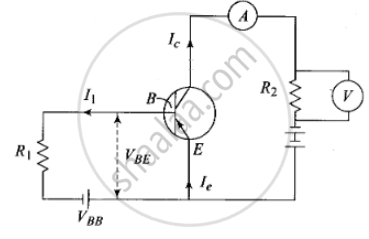
So, `I_BR_1 + V_(BE) = V_(BB)`

Base current, `I_B = (V_(BB) - V_(BE))/R_1`

`I_B ∝ 1/R_1`

So, R1 is increased, IB is decreased.

Now, the current in the ammeter is collector current IC.

IC = βIB as IB is decreased, IC is also decreased and the reading of the voltmeter and ammeter also decreased.

shaalaa.com
  या प्रश्नात किंवा उत्तरात काही त्रुटी आहे का?
पाठ 14: Semiconductor Electronics - Exercises [पृष्ठ ९२]

APPEARS IN

एनसीईआरटी एक्झांप्लर Physics [English] Class 12
पाठ 14 Semiconductor Electronics
Exercises | Q 14.25 | पृष्ठ ९२

व्हिडिओ ट्यूटोरियलVIEW ALL [3]

संबंधित प्रश्‍न

How is a Zener diode fabricated?


If a small voltage is applied to a p-n junction diode, how will the barrier potential be affected when it is (i) forward biased


With what considerations in view, a photodiode is fabricated? State its working with the help of a suitable diagram.

Even though the current in the forward bias is known to be more than in the reverse bias, yet the photodiode works in reverse bias. What is the reason?


Using the necessary circuit diagrams, show how the V-I characteristics of a p-n junction are obtained in

Forward biasing

How are these characteristics made use of in rectification?


Using the necessary circuit diagrams, show how the V-I characteristics of a p-n junction are obtained in

Reverse biasing

How are these characteristics made use of in rectification?


Describe, with the help of a circuit diagram, the working of a photodiode.


The current in the forward bias is known to be more (~mA) than the current in the reverse bias (~μA). What is the reason, then, to operate the photodiode in reverse bias?


Draw the circuit diagram of a full wave rectifier using p-n junction diode.

Explain its working and show the output, input waveforms.


Describe briefly, with the help of a diagram, the role of the two important processes involved in the formation of a p-n junction.


The plate resistance of a triode is 8 kΩ and the transconductance is 2.5 millimho. (a) If the plate voltage is increased by 48 V and the grid voltage is kept constant, what will be the increase in the plate current? (b) With plate voltage kept constant at this increased value, by how much should the grid voltage be decreased in order to bring the plate current back to its initial value?


A p-n photodiode is fabricated from a semiconductor with a band gap of 2.5 eV. lt can detect a signal of wavelength ______.


Which one of the following is not the advantage of LED?


Consider the following statements (A) and (B) and identify the correct answer.

  1. A Zener diode is connected in reverse bias when used as a voltage regulator.
  2. The potential barrier of the p-n junction lies between 0.1 V to 0.3 V.

Briefly explain how emf is generated in a solar cell.


Draw solar cells of I-V characteristics.


What energy conversion takes place in a solar cell?


Share
Notifications

Englishहिंदीमराठी


      Forgot password?
Use app×