English
Karnataka Board PUCPUC Science 2nd PUC Class 12

Three photo diodes D1, D2 and D3 are made of semiconductors having band gaps of 2.5 eV, 2 eV and 3 eV, respectively. Which 0 ones will be able to detect light of wavelength 6000 Å? - Physics

Advertisements
Advertisements

Question

Three photo diodes D1, D2 and D3 are made of semiconductors having band gaps of 2.5 eV, 2 eV and 3 eV, respectively. Which 0 ones will be able to detect light of wavelength 6000 Å?

Short/Brief Note
Advertisements

Solution

In Photodiodes, electron and hole pairs are created by the junction photoelectric effect. That is the covalent bonds are broken by the EM radiations absorbed by the electron in the V.B. These are used for detecting light signals.
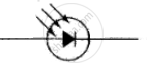

According to the problem,

The wavelength of light λ = 6000 Å = 6000 × 10-10 m

The energy of the light photon `E = (hc)/λ = (6.6 xx 10^-34 xx 3 xx 10^8)/(6000 xx 10^-10 xx 1.6 xx 10^-19)` eV = 2.06 eV

The incident radiation is detected by the photodiode D2 because the energy of incident radiation is greater than the band gap.

shaalaa.com
  Is there an error in this question or solution?
Chapter 14: Semiconductor Electronics - Exercises [Page 92]

APPEARS IN

NCERT Exemplar Physics [English] Class 12
Chapter 14 Semiconductor Electronics
Exercises | Q 14.24 | Page 92

RELATED QUESTIONS

Distinguish between a conductor and a semi conductor on the basis of energy band diagram


Draw separate energy band diagram for conductors, semiconductors and insulators and
label each of them.


Draw energy band diagrams of an n-type and p-type semiconductor at temperature T > 0 K. Mark the donor and acceptor energy levels with their energies.


Distinguish between a conductor, a semiconductor and an insulator on the basis of energy band diagrams.


The conduction band of a solid is partially filled at 0 K. Will it be a conductor, a semiconductor or an insulator?


What is the resistance of an intrinsic semiconductor at 0 K?


Let np and ne be the number of holes and conduction electrons in an intrinsic semiconductor.


When an impurity is doped into an intrinsic semiconductor, the conductivity of the semiconductor


In a semiconductor,
(a) there are no free electrons at 0 K
(b) there are no free electrons at any temperature
(c) the number of free electrons increases with temperature
(d) the number of free electrons is less than that in a conductor.


The electrical conductivity of pure germanium can be increased by
(a) increasing the temperature
(b) doping acceptor impurities
(c) doping donor impurities
(d) irradiating ultraviolet light on it.


A semiconductor is doped with a donor impurity.


The band gap between the valence and the conduction bands in zinc oxide (ZnO) is 3.2 eV. Suppose an electron in the conduction band combines with a hole in the valence band and the excess energy is released in the form of electromagnetic radiation. Find the maximum wavelength that can be emitted in this process.


Suppose the energy liberated in the recombination of a hole-electron pair is converted into electromagnetic radiation. If the maximum wavelength emitted is 820 nm, what is the band gap?

(Use Planck constant h = 4.14 × 10⁻¹⁵ eV-s, Boltzmann constant k = 8·62 × 10-5 eV/K.)


Estimate the proportion of boron impurity which will increase the conductivity of a pure silicon sample by a factor of 100. Assume that each boron atom creates a hole and the concentration of holes in pure silicon at the same temperature is 7 × 10¹⁵ holes per cubic metre. Density of silicon 5 × 1028 atoms per cubic metre.


With reference to Semiconductor Physics,

Draw a labelled energy band diagram for a semiconductor.


Hole are majority charge carrier in


The energy required by an electron to jump the forbidden band in silicon at room temperature is about ______.


Which one of the following elements will require the highest energy to take out an electron from them?

Pb, Ge, C and Si


With reference to semiconductor physics, answer the following question.

What is meant by “Forbidden band" of energy levels?


Share
Notifications

Englishहिंदीमराठी


      Forgot password?
Use app×