Advertisements
Advertisements
प्रश्न
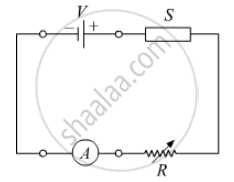
In the following diagram 'S' is a semiconductor. Would you increase or decrease the value of R to keep the reading of the ammeter A constant when S is heated? Give reason for your answer.
Advertisements
उत्तर
As the semiconductors at room temperature act as insulators so they offer very high resistance value. But with the increase in temperature, they start conducting by decreasing the energy-gap and hence they offer less resistivity. So, the resistivity of semiconductors decreases with the increase in temperature and as a result resistance also decreases.
So to maintain the constant reading on the ammeter, we should increase the value of variable resistance R to compensate with the decreased value of resistance for semiconductor.
APPEARS IN
संबंधित प्रश्न
Draw its I – V characteristics of photodiode
The graph shown in the figure represents a plot of current versus voltage for a given semiconductor. Identify the region, if any, over which the semiconductor has a negative resistance.

The power delivered in the plate circular of a diode is 1.0 W when the plate voltage is 36 V. Find the power delivered if the plate voltage is increased to 49 V. Assume Langmuir-Child equation to hold.
A triode value operates at Vp = 225 V and Vg = −0.5 V.
The plate current remains unchanged if the plate voltage is increased to 250 V and the grid voltage is decreased to −2.5 V. Calculate the amplification factor.
In semiconductor physics, what is meant by:
(i) rectifier
(ii) an amplifier
(iii) an oscillator
On increasing the reverse biases voltage to a large value in a P – N junction diode-current
Avalanche breakdown is due to ______.
Consider an npn transistor with its base-emitter junction forward biased and collector base junction reverse biased. Which of the following statements are true?
- Electrons crossover from emitter to collector.
- Holes move from base to collector.
- Electrons move from emitter to base.
- Electrons from emitter move out of base without going to the collector.
Explain the formation of the barrier potential in a p-n junction.
A semiconductor device is connected in series with a battery, an ammeter and a resistor. A current flows in the circuit. If. the polarity of the battery is reversed, the current in the circuit almost becomes zero. The device is a/an ______.
