Advertisements
Advertisements
प्रश्न
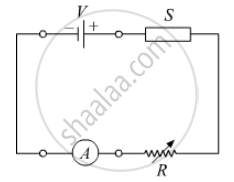
In the following diagram 'S' is a semiconductor. Would you increase or decrease the value of R to keep the reading of the ammeter A constant when S is heated? Give reason for your answer.
Advertisements
उत्तर
As the semiconductors at room temperature act as insulators so they offer very high resistance value. But with the increase in temperature, they start conducting by decreasing the energy-gap and hence they offer less resistivity. So, the resistivity of semiconductors decreases with the increase in temperature and as a result resistance also decreases.
So to maintain the constant reading on the ammeter, we should increase the value of variable resistance R to compensate with the decreased value of resistance for semiconductor.
APPEARS IN
संबंधित प्रश्न
The gain factor of an amplifier in increased from 10 to 12 as the load resistance is changed from 4 kΩ to 8 kΩ. Calculate (a) the amplification factor and (b) the plate resistance.
In semiconductor physics, what is meant by:
(i) rectifier
(ii) an amplifier
(iii) an oscillator
What are the applications of p - n Junction diode?
Figure shows the transfer characteristics of a base biased CE transistor. Which of the following statements are true?

At Vi = 0.4 V, transistor is in active state.
At Vi = 1 V, it can be used as an amplifier.
At Vi = 0.5 V, it can be used as a switch turned off.
At Vi = 2.5 V, it can be used as a switch turned on.
Answer the following giving reasons:
A p-n junction diode is damaged by a strong current.
Describe the following term briefly:
Minority carrier injection in forward biasing.
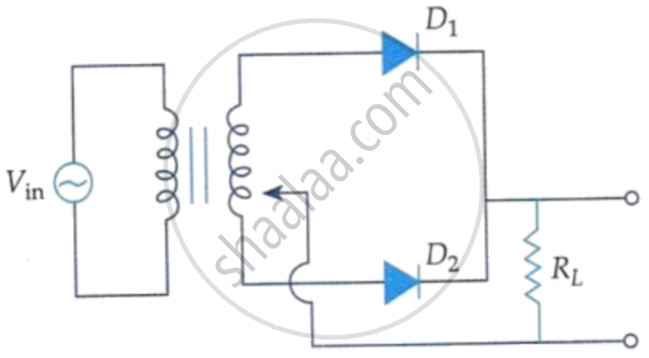
A full wave rectifier circuit diodes (D1) and (D2) is shown in the figure. If input supply voltage Vin = 220 sin (100 πt) volt, then at t = 15 ms.
What is the approximate cut-in voltage of a germanium diode?
What is the approximate cut-in voltage of a silicon diode?
What does the comparison of \[10\,\Omega\] in forward bias and \[1.0\times10^{7}\,\Omega\] in reverse bias show?
