Advertisements
Advertisements
प्रश्न
In the circuit shown in figure, if the diode forward voltage drop is 0.3 V, the voltage difference between A and B is ______.

पर्याय
1.3 V
2.3 V
0
0.5 V
Advertisements
उत्तर
In the circuit shown in figure, if the diode forward voltage drop is 0.3 V, the voltage difference between A and B is 2.3 V.
Explanation:
Let us consider figure 2.3 V given above in the problem, suppose the potential difference between A and B is VAB.
Then, `V_(AB) - 0.3 = [(r_1 + r_2)10^3] xx (0.2 xx 10^-3)` .....[∵ VAB = ir]
= `[(5 + 5)10^3] xx (0.2 xx 10^-3)]`
= `10 xx 10^3 xx 0.2 xx 10^-3`
= 2
⇒ VAB = 2 + 0.3 = 2.3 V
APPEARS IN
संबंधित प्रश्न
What happens when a forward bias is applied to a p-n junction?
In the following diagram 'S' is a semiconductor. Would you increase or decrease the value of R to keep the reading of the ammeter A constant when S is heated? Give reason for your answer.
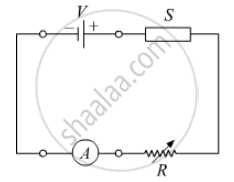
With reference to semi-conductors answer the following :
(i) What is the change in the resistance of the semi-conductor with increase in temperature ?
(ii) Name the majority charge carriers in n-type semi-conductor.
(iii) What is meant by doping ?
The dynamic plate resistance of a triode value is 10 kΩ. Find the change in the plate current if the plate voltage is changed from 200 V to 220 V.
Answer the following question.
Why photodiodes are required to operate in reverse bias? Explain.
Basic materials used in the present solid state electronic devices like diode, transistor, ICs, etc are ______.
Diffusion in a p-n junction is due to ______.
In forward bias width of potential barrier in a p + n junction diode
Use a transistor as an amplition
On increasing the reverse biases voltage to a large value in a P – N junction diode-current
In a semiconductor diode, the barrier potential offers opposition to only
When an electric field is applied across a semiconductor ______.
- electrons move from lower energy level to higher energy level in the conduction band.
- electrons move from higher energy level to lower energy level in the conduction band.
- holes in the valence band move from higher energy level to lower energy level.
- holes in the valence band move from lower energy level to higher energy level.
Consider an npn transistor with its base-emitter junction forward biased and collector base junction reverse biased. Which of the following statements are true?
- Electrons crossover from emitter to collector.
- Holes move from base to collector.
- Electrons move from emitter to base.
- Electrons from emitter move out of base without going to the collector.
 (a) |
 (b) |
- Name the type of a diode whose characteristics are shown in figure (A) and figure (B).
- What does the point P in figure (A) represent?
- What does the points P and Q in figure (B) represent?
Draw V-I characteristics of a p-n Junction diode.
Describe the following term briefly:
Minority carrier injection in forward biasing.
What occurs near the junction when the p-side and n-side are joined?
What is left behind near the junction, creating a depletion layer?
What current flows in the reverse-bias V-I characteristic before breakdown?
How does effective resistance compare between forward bias after the cut-in voltage and reverse bias before breakdown?
