Advertisements
Advertisements
प्रश्न
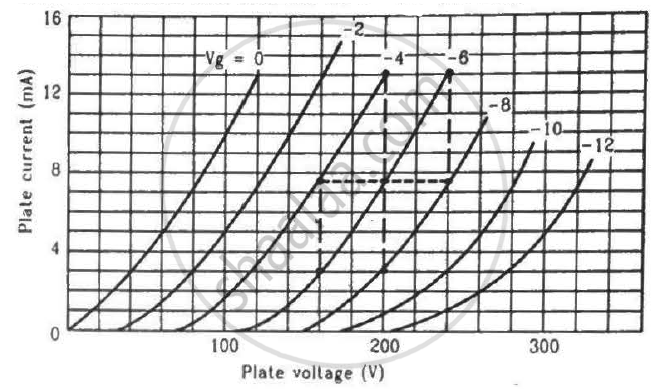
Find the values of rp, µ and gm of a triode operating at plate voltage 200 V and grid voltage −6. The plate characteristics are shown in the figure.
Advertisements
उत्तर
Dynamic plate resistance, `r_p=((deltaV_p)/(deltaI_p)),` at constant grid voltage
We need to find the slope of the graph for a particular value of grid voltage, i.e. Vg = −6 V.
Consider two points for the plot of Vg = −6 V:-
\[r_p = \frac{(240 - 160) V}{(13 - 3) \times {10}^{- 3} A}\]
\[ r_p = \frac{80}{10} \times {10}^3 \Omega\]
\[ r_p = 8 K\Omega\]
\[ g_m = \left( \frac{\delta I_p}{\delta V_g} \right)_{V_P = \text{constant } (200 V)}\]
Consider two points on the 200 V line:-
\[g_m = \frac{(13 - 3) \times {10}^{- 3}}{[( - 4) - ( - 8)]}A\]
\[ g_m = \frac{10 \times {10}^{- 3}}{4}=2.5\text{ mili mho}\]
Amplification factor,
\[\mu = - \left( \frac{∆ V_P}{∆ V_G} \right)_{i_P =\text{ constant}}\]
\[\mu = - \frac{100 - 180}{- 6 - ( - 10)}\]
\[\mu = \frac{80}{4} = 20\]
APPEARS IN
संबंधित प्रश्न
Explain the working of P-N junction diode in forward and reverse biased mode.
In the following diagram, is the junction diode forward biased or reverse biased ?
Why is a zener diode considered as a special purpose semiconductor diode?
In a photo diode, the conductive increases when the material is exposed to light. It is found that the conductivity changes only if the wavelength is less than 620 nm. What is the band gap?
(Use Planck constant h = 4.14 × 10⁻¹⁵ eV-s, Boltzmann constant k = 8·62 × 10-5 eV/K.)
With reference to Semiconductor Physics,
Name the diode that emits spontaneous radiation when forward biased.
In a semiconductor diode, the barrier potential offers opposition to only
Consider an npn transistor with its base-emitter junction forward biased and collector base junction reverse biased. Which of the following statements are true?
- Electrons crossover from emitter to collector.
- Holes move from base to collector.
- Electrons move from emitter to base.
- Electrons from emitter move out of base without going to the collector.
Figure shows the transfer characteristics of a base biased CE transistor. Which of the following statements are true?

At Vi = 0.4 V, transistor is in active state.
At Vi = 1 V, it can be used as an amplifier.
At Vi = 0.5 V, it can be used as a switch turned off.
At Vi = 2.5 V, it can be used as a switch turned on.
In the depletion region of a diode ______.
- there are no mobile charges.
- equal number of holes and electrons exist, making the region neutral.
- recombination of holes and electrons has taken place.
- immobile charged ions exist.
The breakdown in a reverse biased p–n junction diode is more likely to occur due to ______.
- large velocity of the minority charge carriers if the doping concentration is small.
- large velocity of the minority charge carriers if the doping concentration is large.
- strong electric field in a depletion region if the doping concentration is small.
- strong electric field in the depletion region if the doping concentration is large.
A Zener of power rating 1 W is to be used as a voltage regulator. If zener has a breakdown of 5 V and it has to regulate voltage which fluctuated between 3 V and 7 V, what should be the value of Rs for safe operation (Figure)?

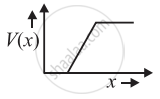
The graph of potential barrier versus width of depletion region for an unbiased diode is shown in graph A. In comparison to A, graphs B and C are obtained after biasing the diode in different ways. Identify the type of biasing in B and C and justify your answer
| ‘A’ | ‘B’ | ‘C’ |
 |
 |
 |
Write the property of a junction diode which makes it suitable for rectification of ac voltages.
Answer the following giving reasons:
A p-n junction diode is damaged by a strong current.
Draw the circuit arrangement for studying V-I characteristics of a p-n junction diode in (i) forward biasing and (ii) reverse biasing. Draw the typical V-I characteristics of a silicon diode.
Describe the following term briefly:
Breakdown voltage in reverse biasing
What occurs near the junction when the p-side and n-side are joined?
Which practical effect is associated with reverse bias before breakdown?
Which formula gives the forward dynamic (AC) resistance?
