Advertisements
Advertisements
प्रश्न
The plate current in a diode is 20 mA when the plate voltage is 50 V or 60 V. What will be the current if the plate voltage is 70 V?
Advertisements
उत्तर
For 50 V or 60 V, the plate current is 20 mA. That means 20 mA is the saturation current.
At the given temperature, the plate current is 20 mA for all other values of voltages.
Thus, the current at 70 V will be 20 mA.
APPEARS IN
संबंधित प्रश्न
(i) Explain with the help of a diagram the formation of depletion region and barrier potential in a pn junction.
What happens when a forward bias is applied to a p-n junction?
What causes the setting up of high electric field even for small reverse bias voltage across the diode?
Draw its I – V characteristics of photodiode
With reference to semiconductor devices, define a p-type semiconductor and a Zener diode.
The gain factor of an amplifier in increased from 10 to 12 as the load resistance is changed from 4 kΩ to 8 kΩ. Calculate (a) the amplification factor and (b) the plate resistance.
A – pn junction has a depletion layer of thickness .of the order of
Depletion layer in p - n junction diode consists of
Use a transistor as an amplition
In Figure, Vo is the potential barrier across a p-n junction, when no battery is connected across the junction ______.

Consider an npn transistor with its base-emitter junction forward biased and collector base junction reverse biased. Which of the following statements are true?
- Electrons crossover from emitter to collector.
- Holes move from base to collector.
- Electrons move from emitter to base.
- Electrons from emitter move out of base without going to the collector.
Consider a box with three terminals on top of it as shown in figure (a):
 (a) |
Three components namely, two germanium diodes and one resistor are connected across these three terminals in some arrangement. A student performs an experiment in which any two of these three terminals are connected in the circuit shown in figure (b).
 (b) |
The student obtains graphs of current-voltage characteristics for unknown combination of components between the two terminals connected in the circuit. The graphs are
(i) when A is positive and B is negative
 (c) |
(ii) when A is negative and B is positive
 (d) |
(iii) When B is negative and C is positive
|
(e) |

(iv) When B is positive and C is negative
 (f) |
(v) When A is positive and C is negative
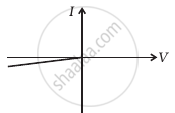 (g) |
(vi) When A is negative and C is positive
 (h) |
From these graphs of current-voltage characteristics shown in figure (c) to (h), determine the arrangement of components between A, B and C.
Differentiate between the threshold voltage and the breakdown voltage for a diode.
Explain the formation of the barrier potential in a p-n junction.
When the p-side and n-side are joined, in which direction do electrons diffuse?
What opposes further diffusion in the depletion layer?
What is the approximate cut-in voltage of a germanium diode?
What is the approximate cut-in voltage of a silicon diode?
What current flows in the reverse-bias V-I characteristic before breakdown?
How does effective resistance compare between forward bias after the cut-in voltage and reverse bias before breakdown?
